
PHOTO
On a brisk July day in 1901, the regular hum of activity on Summer Street was disturbed by an unusual sound. Turning to identify the source of the noise, passersby found themselves involuntarily crying out in surprise at the bizarre, totally unexpected sight that greeted them. There, travelling along the street from the east, was a man sitting astride a small four-wheeled vehicle moving entirely under its own power – the very first motor car seen in Orange.
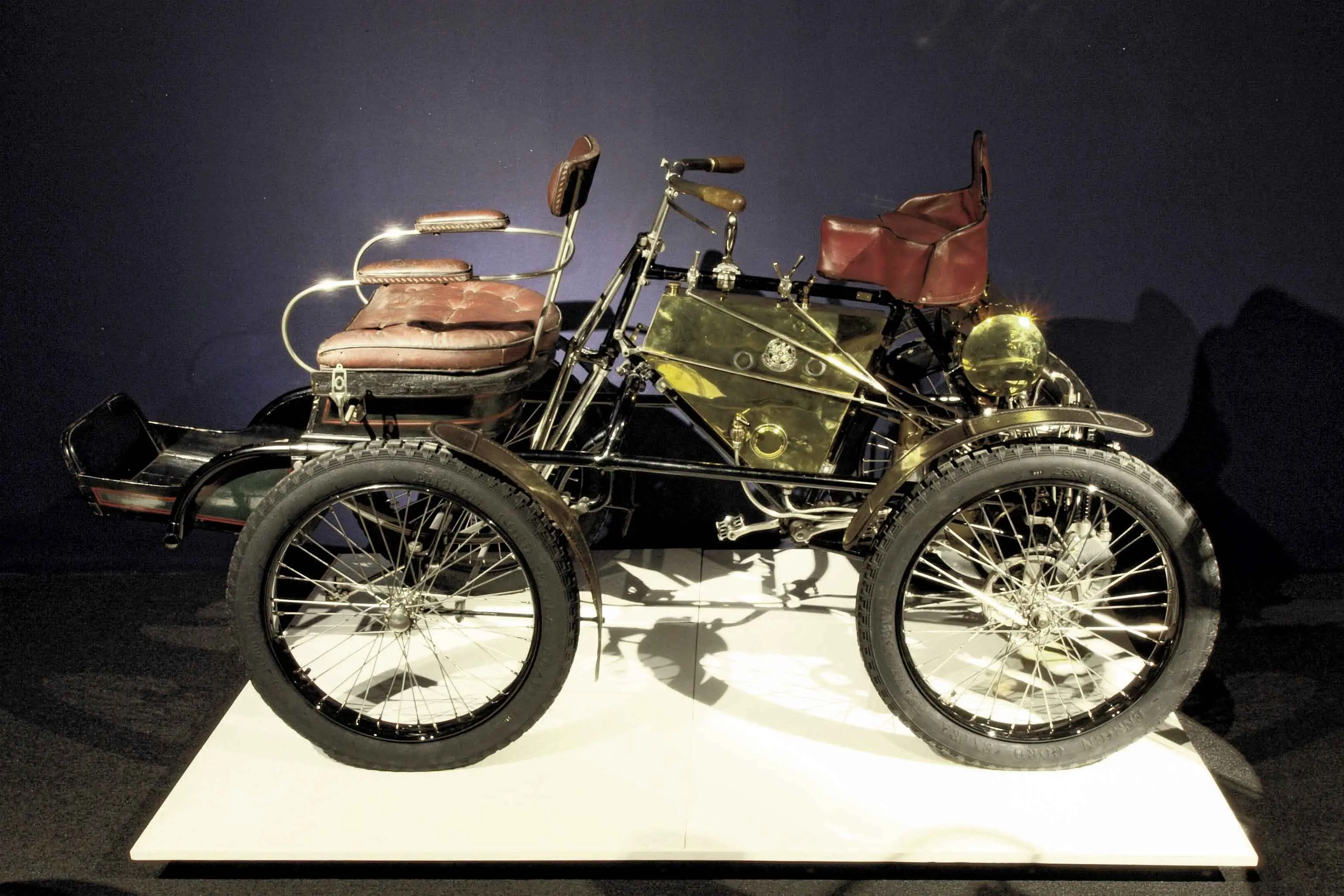
Calling it a car would be a bit of a stretch by today’s standards, as the vehicle in question was closer in appearance to a four-wheeled motorcycle, with the driver’s seat identical to that on a bicycle.
“Though diminutive in size, the motor referred to seems well up to the work expected of it,” wrote the Orange journalist of the day, who was impressed by the little machine.
“It can travel up to 25 miles an hour or more, and beat the fastest trotting horse without much trouble on an ordinary track… The most noticeable feature of the novel machine is the ease, suddenness and rapidity with which it can be turned in any direction, or right round if necessary. It can be steered more easily than the bike and stopped in a shorter distance.”
Besides the speed and manoeuvrability of the vehicle, the practical benefits of doing away with horses were also immediately apparent to the writer.
“It is claimed that a gallon of petroleum will provide all the oil required to be burnt in a journey of 90 miles. This is cheaper than horsefeed, where your animal has to be stabled. It is safe to say that the present generation will see our loaded lorries and waggons, now hauled by horses, delivering goods from the railway station at the stores in town, and shifting municipal road metal and other heavy material in a horseless cart.”
The vehicle that had made this historic journey over the Blue Mountains from Sydney to Orange was a French-made 2 1/2 horsepower De Dion Bouton quadricycle, driven by Bert E. Broue, a sometime journalist, aspiring politician, mining expert, and early motoring enthusiast.
Mr Broue had made the journey to Orange in nine hours and 23 minutes of driving time, with plenty of stops on his way over the mountains for people to marvel at the machine.
However, not everyone was so pleased to see Mr Broue and his motor car, as he relayed in a newspaper account of his adventure, “Two Thousand Miles on a Motor: A Pioneer Trip”.
“As we began to approach Bathurst, meetings on the road begin to get frequent, and the language of the drivers is not what would be termed ‘strictly Parliamentary’,” Mr Broue wrote.
“The motor and the horse very seldom become ‘bosom friends’ at first meeting, and, as a matter of fact, neither do the ‘motorist’ and the driver, one gentleman from the ‘Emerald Isle’ going so far as to inform me that it was his great desire to burn myself and my ‘pompom’.
“At another village, after a bolting team had been checked in its wild career, someone suggested to the ‘open-mouthed’ owner that the noise of the machine frightened his horses. ‘No fear!’ promptly came the answer. It’s the smell of the ‘dorgasted’ electricity…”
From Orange, Mr Broue continued his journey west, causing a sensation wherever he appeared.
“The machine had four wheels and was the size of an ordinary dining table,” was the description given to readers of the Molong Express.
“In great style, and rattling pace, they drove up and down Bank Street to the astonishment of many onlookers.”
In Wellington, big crowds turned out in the streets as the machine passed by, and there was a similar welcome for Mr Broue in Dubbo, where he was praised as being “the first rider who has come this far west with such an up-to-date travelling machine”.
Mr Broue next made his way to Trangie, Nyngan, and Cobar, before turning back through Nymagee, Hermidale, and on to Parkes and Forbes, where he was amused to watch heads “bobbing up” from old mining claims as he passed.
“Many and varied were my experiences at Grenfell and Young,” Mr Broue recounted, “and on the outward run from Sydney through Goulburn and then on to Wagga Wagga…”
It was here, in Wagga, that Mr Broue’s journey seems to have come to an end, when he found himself hauled in front of the police court for travelling at a speed of 10 miles per hour, when the allowed limit was no faster than a walking pace!
After hearing the case, which involved several witnesses, the judge remarked that under the by-law in question there was no actual penalty, and after some discussion, the case was dismissed.
In closing the account of the trip, Mr Broue humbly claimed it had been the longest motor car journey ever undertaken in Australia. An amazing feat, but that was never really the sole aim.
The little motor vehicle that had been the first to navigate thousands of miles of road across NSW was not Mr Broue’s, but the property of Dixson and Sons tobacco manufacturers of Sydney. The purpose of the trip: to advertise Dixson’s Yankee Doodle tobacco.