
PHOTO
Pastoral care for our first responders is a well-established principle in a range of emergency service fields from the police, paramedics, hospital workers, and Fire and Rescue, but what about volunteers who also face life-changing traumas?
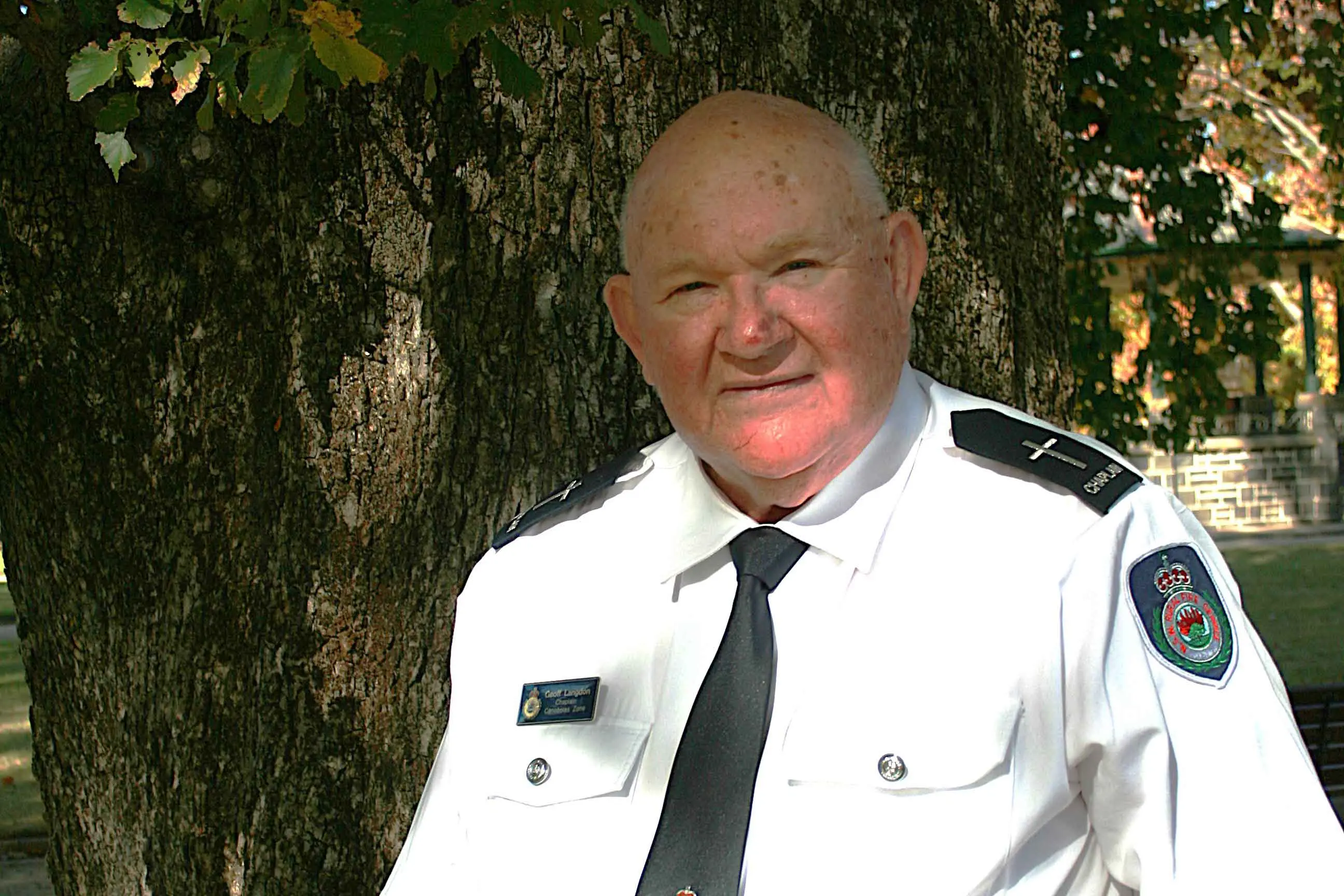
Geoff Langdon services local community firefighters by providing comfort, support, and guidance for those who combat our most devastating natural disasters and who also regularly attend serious car accidents in the region.
Two decades as chaplain for Canobolas Zone of the Rural Fire Service (RFS) have given him a window into the work of everyday locals who can face extreme situations so as to aid their local communities.
“It started in the 1990s when Phil Koperberg was head of the Rural Fire Service, he approached the Salvation Army’s Ron Anderson about setting up a chaplaincy service for the RFS,” Langdon recalled.
“Ron said he would do it, but only on the condition that he would do it for all Christian denominations,” he added.
Since that time, Geoff explained, chaplains have been appointed from a variety of faiths and religions to the RFS.
“I’m a retired Baptist minister, for instance, and I believe there are a couple of Muslim chaplains in the city’s south-west.
“My work primarily involves providing spiritual support when needed for those who, say, have been involved in car accidents, or for RFS volunteers who also need support,” Langdon said.
While our volunteer firefighters are there helping out in the heat of a crisis, Chaplain Langdon’s work is often at its most important following these traumatic events.
“I’ve never been to a fire, but I often attend debriefings after major fires and car accidents; even though they are voluntary, the RFS members in the district seem to get called out for a lot MVA (motor vehicle accidents) as well.
“People who have come through these experiences can sometimes be seen to be struggling, or they come to me to discuss issues they are facing,” Langdon said.
Now 20 years into a vocation he took-on largely unsighted, he wouldn’t have it any other way.
“Although it can sometimes be hard, it’s a very rewarding job indeed. I’ve always had a desire to help people when I can.
“I’m normally only called out for major events or an RFS volunteer who is not coping' I sometimes just talk to them and listen, I’ve been told I’m a good listener,” Langdon admitted.
While our volunteer firefighters are often seen as unsung heroes in our rural communities, there is a personal cost to the work they do.
“After the ‘Black Saturday’ fires in Victoria, at which there some fire crew from here, I was asked to be out at the airport to help people who were traumatised by what they had seen, some were very emotional.
“Another instance was a time when a car had hit some black ice and collided with a tree, that was also very traumatic for the RFS crews,” Langdon said.
He emphasised that his role is basically to provide spiritual and emotional comfort to those who come to him, and he is not a professional counsellor.
“I would say my prime role is to provide support, encouragement, and comfort and to recommend further assistance to those requiring mental health expertise.
“People can call me directly or go through the RFS, but I can only take people so far,” he said.
Not getting any younger, he said that the RFS is always keen to hear of people with religious training who may want to take up the role for other areas of the state.
“Not all positions are filled, it’s often hard to find someone, especially in country areas,
“I wouldn’t say it’s the type of job I enjoy as such, but it has offered me a great deal of satisfaction and appreciation of the work of the RFS,” he concluded.