
PHOTO
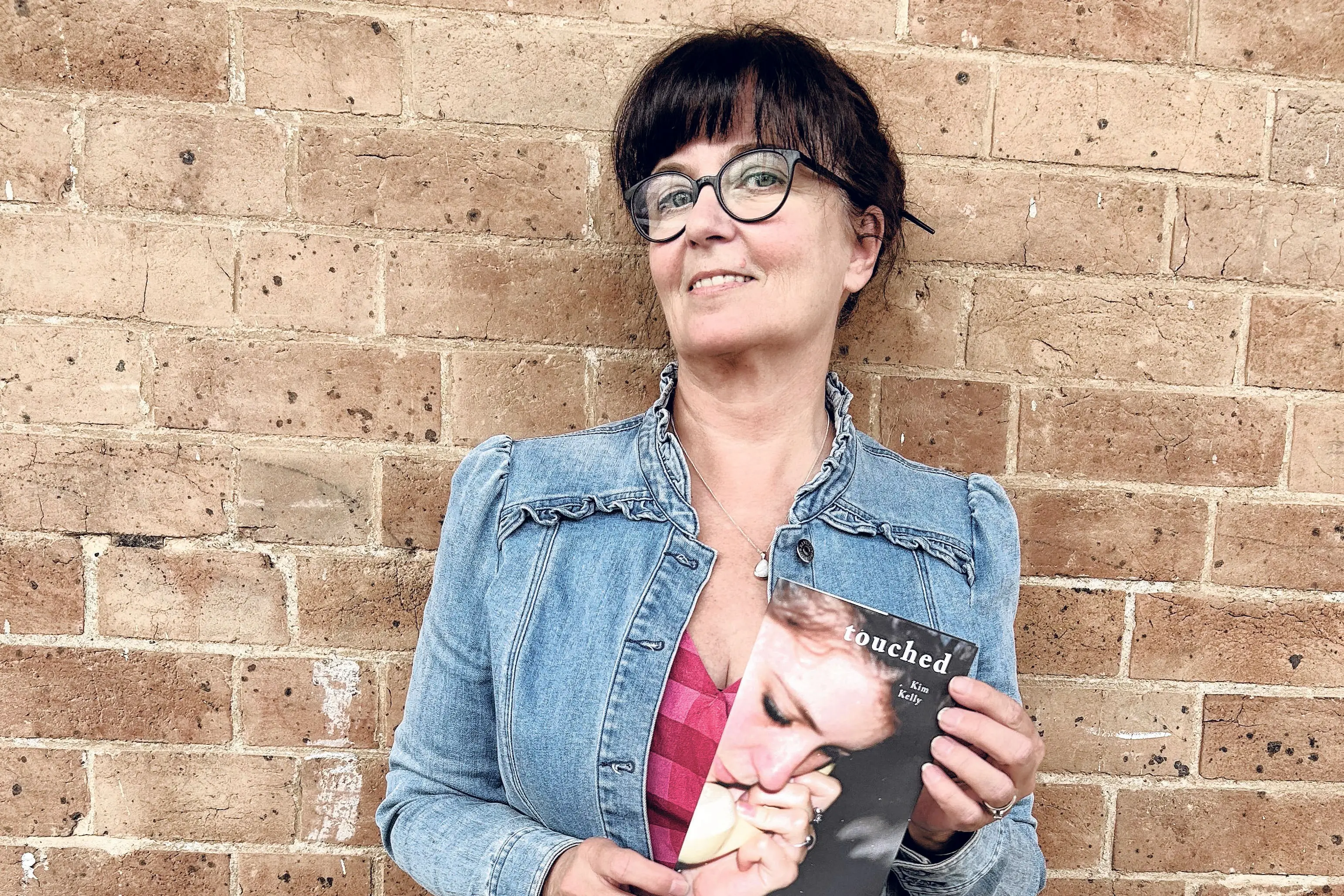
Kim Kelly has published more than fourteen books, won shelves of praise, and taught hundreds of emerging writers — yet she still calls herself “an anxious person” riddled with self-doubt. So much so, that her latest award-wining publication ‘Touched’ is the memoir of her anxiety.
“I think people can’t tell that I’m the one who has anxiety because I have this sort of performer button that gets pressed as soon as the lights are on,” she laughs. “As soon as the lights are on, I’m away.”
That mixture of nervous energy and effervescent storytelling seems to define her. Kelly speaks in torrents — laughter and philosophy tumbling together — with the kind of generosity you might expect from someone raised in what she calls “a house full of books and stories and people.”
Kelly grew up in Sydney's La Perouse, “a very historical area in terms of the settlements,” she recalls. Her childhood was steeped in stories — from Aboriginal friends whose elders’ histories were simply part of everyday conversation, to her own family’s tales of struggle and reinvention. Her family is Irish on her mum’s side and part-German on the paternal side with an English Ashkenazi Jew in the mix, too.
“I don’t remember a time of not knowing about colonialism,” she says. “When you grow up with close Aboriginal friends and the stories of their elders, it’s just part of your knowledge base.”
The Kelly dinner table was famously lively. “Entertaining Dad when he was in a good mood was an important family thing to do,” she smiles. “I was expected to be an entertaining oral storyteller. That was expected — both my brother and I.”
Music played too: “We did not end a family dinner without 'Zorba the Greek' being played and crazy dancing. Laughter and talking, talking, talking.”
Her parents were both readers — her father an English teacher and her mother “a big reader of Australian fiction and crime thrillers… everything from Dickens to Dan Brown.” She devoured Frank Hardy’s ‘Power Without Glory’ feeling it was her own story, and re-read ‘Picnic at Hanging Rock’ at least six times.
But it was her family’s ordinary dramas that planted the deeper seed.
“All of the financial misfortunes in my family are very much tied to the misfortunes of ordinary people in Australian history,” she says of her family’s history of serial bankrupts. “I’m fascinated by the epic in the ordinary. Whatever has brought us here to this moment… whoever they were, they made massive decisions, faced massive challenges.”
From that fascination grew her drive to write the “real” Australia — not the mythologised one of diggers and battlers, but a country seen from kitchen tables and back lanes. “Every person you meet almost is an immigrant in some way,” she says. “All that movement is epic when you think of the disruption.”
Kelly’s path to authorship wasn’t straightforward. “I thought books were made by clever people. I thought there was magic, witchcraft, warlockery involved — that an otherwise ordinary kid like me didn’t have access to.”
After university and a few “shit-happens life events”, she landed a maternity-leave fill-in job at Random House as an editorial assistant. “Within two weeks I was sitting there with a bunch of page proofs… and I went, this is how books are made. And they’re full of mistakes!” she laughs. “The scales fell from my eyes.”
Ten years of editing for Random House and HarperCollins, producing around 300 books, became her apprenticeship: “That combination of creativity but also hard work and learning that goes into making books.” Even then, she hesitated to share her own writing.
“I’d always written,” she says, “but it was just something I didn’t think was shareable.”
Eventually, she took three months off work, lied to her clients that she was “too busy,” and wrote her first novel ‘Black Diamonds’. Her mother — “not an incredibly supportive mother, but supportive of my desire to write” — urged her on. “She said to me, stop talking about it, just get on with it.”
When her mother died suddenly before finishing the manuscript, Kelly turned the loss into purpose: “I’ve never stopped writing since. I used her name — Kelly — for all my writing. Mum’s in everything.”
Despite her success, self-doubt is still part of the process. “Absolutely,” she says. “But if I didn’t have those moments, I’d worry.”
She sees doubt as a creative tool. “Most of writing a narrative is problem-solving — whether it’s at the sentence level, the paragraph level, or the structural level. It’s all about identifying and fixing problems.”
Her advice to students at Macquarie University, where she now teaches creative writing, is both practical and compassionate. “If you’re not interested at a deep level in what you’re writing, you’re going to find it that much harder to get there. But if you’ve got that deep drive, that little engine’s gonna keep ticking over.”
And she reassures them: “It’s normal... ‘This is terrible, Oh, I’m a failure, I shouldn’t be writing’ it’s part and parcel of learning anything. You don’t decide to run a marathon and then do it next weekend.”
Kelly’s fiction seeks to uncover what she calls “the ground-up truths” of Australia — the overlooked, the inconvenient, the human. “Part of my consciousness in writing stories set in regional areas is to say, look at this from a different perspective. This isn’t about the big ticket items of Australian history. It’s about what’s interesting at the everyday level.”
When she and her partner Dean moved to the Central West in 2013, she found a new dimension of the country she loves. “As much as I say I don’t belong anywhere, I do feel a sense of peace where we are. It’s one place where I don’t feel unwelcome.” They now live on an acreage outside Millthorpe. But forget the illusion of the successful author secluded in a grand study: Kim sits and types on the sofa, oblivious to whatever noises and distractions happen around her.
“I don’t have a connection to place — I have connection to people,” she says. “Maybe it’s a chicken-and-egg thing. Does the anxiety exist because I don’t have the connection to place? Or am I an outsider because of the anxiety?”
She insists that reading is still the best teacher. “Your favourite authors — or authors even that you don’t like — are your first training ground. If you don’t understand what you love, how can you formulate your own stuff?”
After decades of writing, teaching, and editing, she’s still chasing the same impulse that filled her childhood home: curiosity. “I make connections really easily,” she says. Her La Perouse upbringing — “highly multicultural, lots of different languages, lots of different cultural backgrounds” — taught her that “everybody’s got a story, and most people actually do want to tell it.”