
PHOTO
On Sunday, May 31, a small crowd of locals took part in a memorial for soldiers of the Orange District who fought in South Africa during the Second Boer War of 1899-1902.
Some 170 locals volunteered to fight in the conflict, four of whom would never return.
Another who followed the war drums to South Africa, although wielding a pen rather than a rifle and bayonet, was Orange’s favourite literary son, Andrew “Banjo” Paterson, who went as a newspaper correspondent for 'The Sydney Morning Herald' and 'The Age'.
Banjo was just one of hundreds of correspondents drawn to the war, which was one of the most widely reported conflicts of its time.
Among the more reputable cadre of correspondents reporting from South Africa were the author and poet Rudyard Kipling and future British Prime Minister Sir Winston Churchill, who was famously captured by the Boers and made a daring escape to freedom.
William Lambie is another name of note, although less known today. Embarking for the Boer War, he was considered to be one of Australia’s more senior journalists at the front.
Lambie had come into prominence having been one of three journalists chosen to sail with the NSW Contingent to the Sudan in 1885. There, he won laurels for his bravery along with the dubious honour of being the first Australian war correspondent wounded in action.
As a journalist in South Africa, Lambie was fated to acquire another “first”, becoming the first Australian war correspondent to be killed while on assignment.
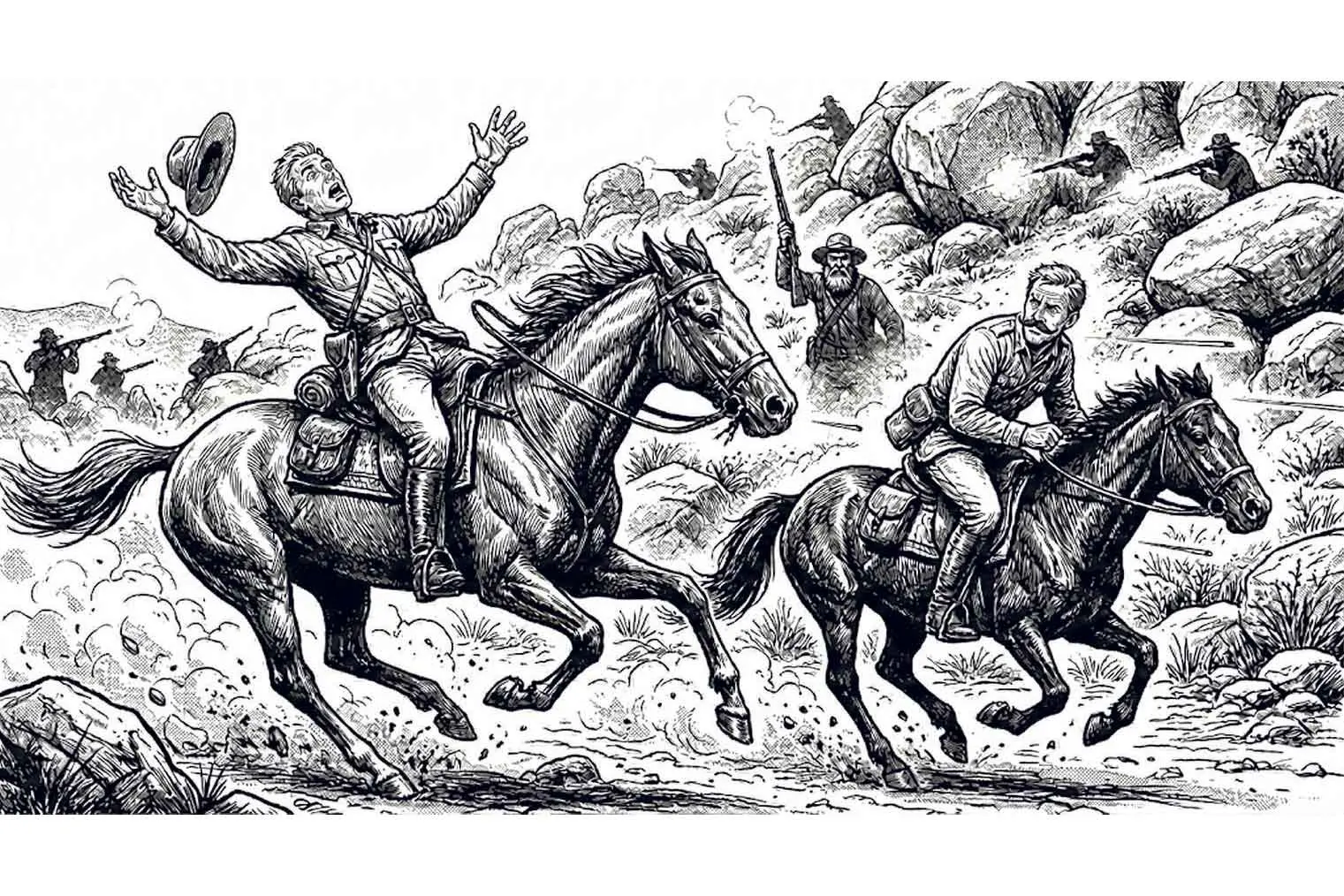
Lambie and fellow Australian correspondent A.G. “Smiler” Hales were riding with a band of Tasmanian troopers near Jasfontein in Natal Province on February 9, 1900, when they were ambushed by a party of Boers.
Ignoring rifle fire and shouts to surrender, Lambie and Hales made a bolt for it, but did not make it far, as Hales later reported:
“A voice called in good English: ‘Throw up your hands, you damned fools.’ But the galloping fever was on us both, and we only crouched lower on our horses' backs, and rode all the harder, for even a barnyard fowl loves liberty.
“All at once, I saw my comrade throw his hands up with a spasmodic gesture. He rose in his stirrups, and fairly bounded high out of his saddle, and as he spun round in the air, I saw the red blood on the white face, and I knew that death had come to him sudden and sharp.”
Hales earned his own “first” from the incident, becoming the first Australian war correspondent to be taken prisoner while on duty. On regaining consciousness from the bullet that grazed his skull, Hales reports that the Boer leader who took him prisoner chastised him for the avoidable death of Lambie:
“You dress exactly like two British officers; you ride out with a fighting party, you try to ride off at a gallop under the very muzzles of our rifles when we tell you to surrender. You can blame no one but yourselves for this day's work."
Hales was an outspoken critic of British media censorship during the war in South Africa, which he said was mostly about the military leadership hiding their blunders from the public.
While lionising those he thought deserving, Hales despised many of the British officer class he encountered, describing them as “foppish”, “drawing-room dandies”, “camp swashbucklers”, and worse.
“I have seen mere lads in this country leading men into action who in point of brains were not fit to lead a mule to water, and others who, in regard to manners, were scarcely fit to follow the mule.”
In this, he made an enemy of Churchill, whom he later accused of thwarting his efforts to gain an official correspondent post at the outbreak of World War I.
But Hales was a resourceful man. He’d previously fought with Bulgarian partisans against Ottoman rule in Macedonia and made a perilous overland journey throughout Asia after covering the Russo-Japanese War in 1905. Taking his eldest son with him, he financed his own trip to the front, where he is said to have written the very first published account of aeroplane combat for a London newspaper.