
PHOTO
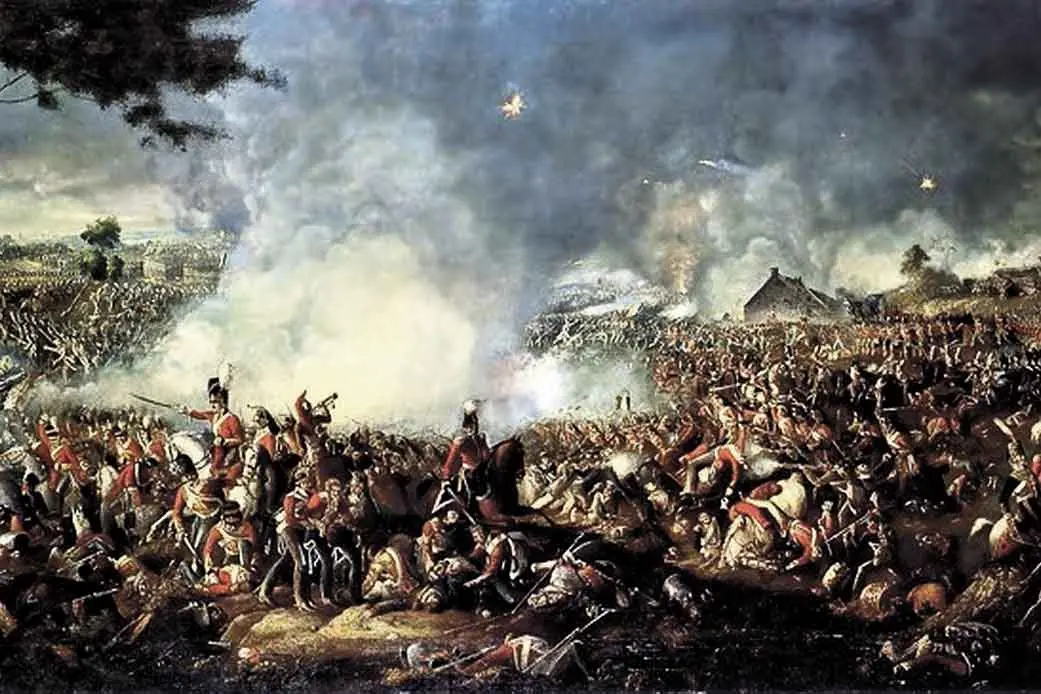
The past few weeks saw the 211th anniversary of the Battle of Waterloo: The decisive victory of the armies led by the Duke of Wellington against the French Emperor Napoleon on June 18, 1815, that brought an end to decades of war on the continent and reshaped the balance of power in Europe.
But the impact of the battle, in what is now Belgium, and the end of the long war was felt far beyond the boundaries of Europe. Britain had gained possession of numerous rich French colonies and strategic strongholds, cementing its place as a global superpower.
And British colonies like Australia soon saw an influx of out-of-work veterans looking to make a new life for themselves. These veterans of the Napoleonic Wars played an oversized role in shaping all aspects of Australian colonial life during the 1820s and 1830s.
Here in the Central West, the legacy of Waterloo and what is known as "the Peninsular War", the war fought against Napoleon in Spain and Portugal, is literally written across the countryside.
Our neighbouring city of Bathurst was named in the same year as Wellington’s victory for his superior, the British Secretary of State for War and the Colonies, Henry Bathurst, 3rd Earl Bathurst. Then, of course, there is the town of Wellington itself, named for the “Iron Duke” himself, which sits on the river below the three mountain peaks, Arthur, Wellesley, and Duke (Arthur Wellesley being the given name of the Duke of Wellington).
Vittoria takes its name from Wellington’s victory over the French in Spain on June 20, 1813, which brought an end to the Peninsula War.
In our immediate vicinity in the County of Bathurst, the parishes disproportionately bear names of Napoleonic War veterans, due entirely to Surveyor Major Thomas Mitchell, who had served with the 95th Rifles in the Peninsular War.
ORANGE, of course, takes its name from William, Prince of Orange and later King William II of the Netherlands. The young prince, when still a teen, was aide-de-camp to Wellington during the Peninsular War, where Mitchell made his acquaintance. The Prince commanded the “I Corp” at Waterloo, where he was wounded in the shoulder.
But there are another 20 more nearby parishes named for officers who served either at Waterloo, or at the Peninsular.
ANSON: Named after General George Anson, who led a brigade of light cavalry at the Battles of Talavera, Busaco, Salamanca and Vittoria.
BEAUFORT: Named for the three sons of the Duke of Beaufort, John, Edward and Fitzroy Somerset, who were on the staff of the Duke of Wellington at Waterloo.
BYNG: General Sir John Byng commanded the 2nd Brigade Guard at Quatre Bras and Waterloo.
CADOGAN: Colonel Henry Cadogan, 71st Highlanders, was killed charging at the head of his men at Vittoria.
CALVERT: General Harry Calvert, Adjutant General of the Army.
CLINTON: General Sir Henry Clinton commanded the Allied 2nd Division at Waterloo
COLE: After General Sir Galbraith Lowry Cole, wounded at the Battle of Albuera in which he played a decisive part. He was also wounded, much more seriously, at Salamanca.
COLVILLE: General Charles Colville, who commanded the 4th Infantry Division at Waterloo.
ERROL: After the family of Lord James Hay, killed at Quatre Bras, Spain. He was the son and heir of William Hay, 17th Earl of Erroll.
FREEMANTLE: Lieutenant-General John Freemantle, aide-de-camp to Wellington at Waterloo.
GALBRAITH: After General Sir Galbraith Lowry Cole (see above).
GRAHAM: General Sir Thomas Graham of Balgowan, knighted after the capture of Ciudad Rodrigo, commanded at the siege of San Sebastian.
GRANTHAM: Lieutenant Val Grantham, 95th Rifle, brother officer of Mitchell. Served at Waterloo.
HUNTLEY: After the 9th Marquess of Huntley, Colonel of the 92nd Gordon and 42nd Highlanders.
LOWRY: After General Sir Galbraith Lowry Cole (see above).
NAPIER: Three Napier brothers served with distinction during the Peninsular War. Sir George Thomas Napier lost his arm, leading the “Forlorn Hope” at Ciudad Rodrigo in 1812.
PONSONBY: Major-General Sir William Ponsonby commanded the 2nd Heavy Cavalry Brigade at Waterloo.
SHADFORTH: Lieutenant-Colonel Thomas Shadforth, 57th Regiment, wounded at Albuera, Spain and later served with the regiment in Sydney.
TORRENS: Lieutenant-Colonel Sir Robert Henry Thomas Torrens received the Companion of the Order of the Bath and the Second Class of the Order of St Anne for valour and distinguished service at Waterloo.
WALDEGRAVE: Lieutenant-Colonel John James Waldegrave, 6th Earl Walgrave, served in the Peninsular War and commanded the 54th Foot at Waterloo.
*For the above information, we are indebted to the work of Watson A. Steel of the Royal Australian Historical Society.