
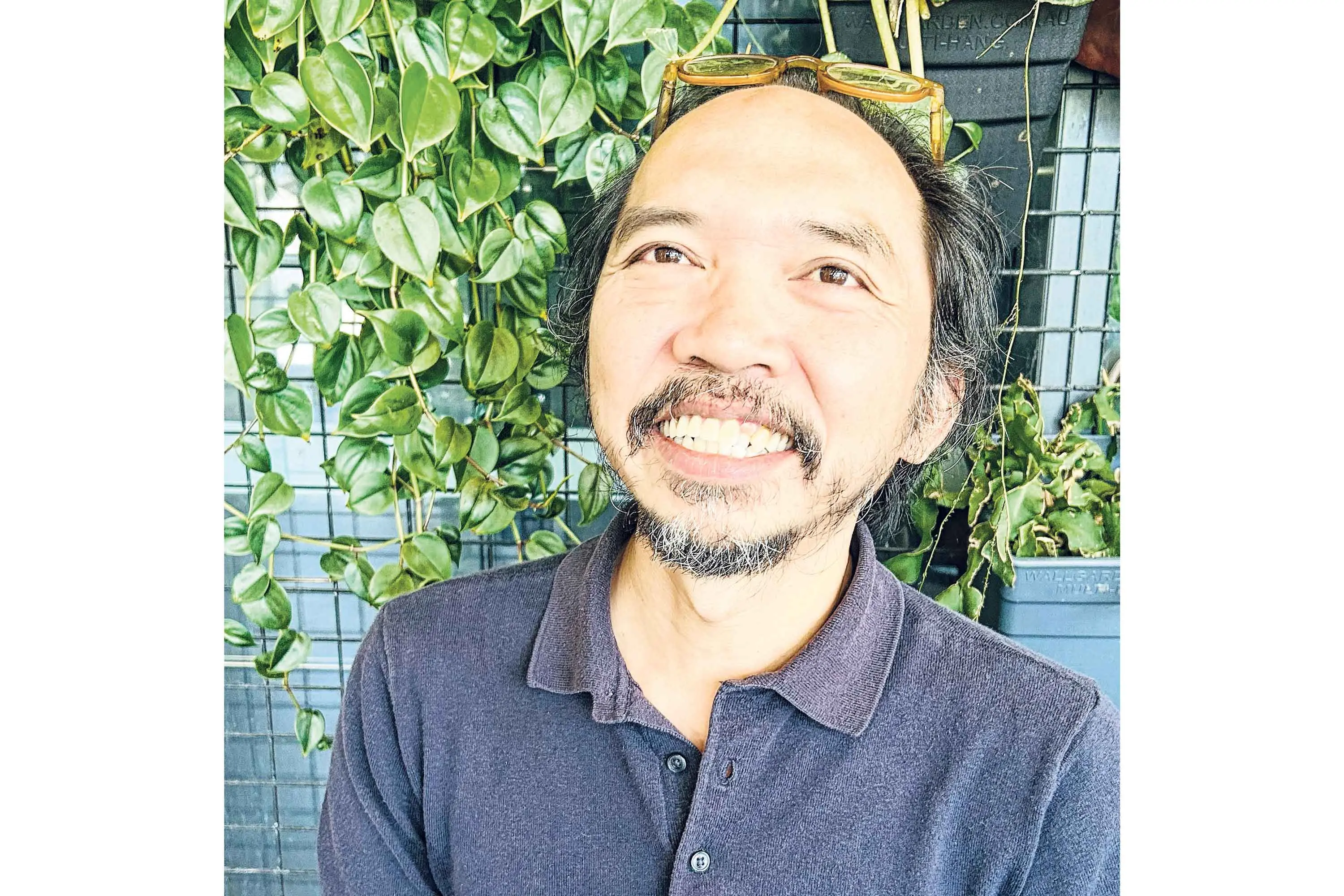
PHOTO
Antariksa is a curious soul. In all senses of the word. From humble beginnings as the son of a “low level civil servant” in Surabaya, Indonesia, he has taken his art to places as far-flung as Belgium, Austria, Japan, the Netherlands, and a castle in Germany.
He’s even been a professor at the NTU Centre for Contemporary Art in Singapore, and at the National Institute of Social Sciences (NISS) in Paris.
And the journey to get there is as scary as it is fascinating.
Antariksa's father exposed him to creativity and music, especially 'keroncong' songs, an Indonesian jazz-like fusion of influences from Portuguese sailors who arrived in the archipelago as early as the 16th century. His mum was a singer, and the radio was always on. But it was visual art not audio where his creative future lay.
At school he studied German (it was compulsory to study a foreign language, the national language, the local dialect, plus Arabic because he’s Muslim) and his teacher passed him a book, translated as 'The Dream of a Mermaid'. “I really loved it. I asked my teacher, ‘What is this? I want to study something like this'." The teacher explained it was philosophy.
“When I propose to my parents, I want to go to Gaja Mata Uni, they so proud because they have no clue, but as long as I go to this university, they fine.” Gadja Mada was the first — and biggest — national university in the nation. “Philosophy gave me foundation for critical thinking. Can you get job when you study Western Philosophy? I don't really care.”
Suddenly the young man was thrust into the bohemian furnace of Yogyakarta: “It's very relaxed. You live among artists, among creative peoples.” The contemporary art scene was exploding. “I know a lot of artists, thousands of exhibitions.” On top of that was an incredibly low cost of living. “The pressure to get normal people's job was really low,” he flashes one of his ever-ready grins. “No pressure.” He brought in cash by doing Indonesian subtitles for Hollywood movies, a good way to improve his English.
But while this all sounds idyllic there was dark underside: The Suharto regime had installed the ‘New Order’ since the mid-1960s, which meant more military muscle inside of government. Typical restrictions included banning works suspected of leftist or critical themes; state approval required for publications, theatre, and film; monitoring of universities and cultural groups; and blacklisting artists associated with communist or dissident circles.
Antariksa and his free-thinking buddies were targeted. “Not only censorship, they will just kill you. My friends would die a lot ... kidnapped and then disappear,” he says matter of factly. Talk about suffering for your art.
Bachelor's degree completed, he signed up for a master's degree in art history at the Jesuit-run Sanata Dharma University, also in Yogya. His specialty became the art from the Japan-occupied parts of Asia in World War 2, including propaganda art, a niche he continues to pursue almost forensically.
He and his friends began pushing back even further against the oppressive regime. They used installation art, symbolism, humour, and participatory works to evade censorship while still critiquing the regime.
Then came the internet, and things went next level. “I was involved with student movement. And my job was creating underground publications. I contacted the Indonesian exiles abroad to give me materials to criticise the regime. And this opened up the whole new world for me and a group of friends.” They also took part in demonstrations against the lack of freedom of speech, calling for ‘Reformasi’.
The authorities came for him. “So I moved to different places, sleep in the church, making underground publications, using church computers, that kind of stuff.”
Economic collapse during the Asian Financial Crisis of 1997 triggered mass protests. Then finally in May 1998 the regime collapsed in the face of the power of the people.
It was a moment of electric release. Overnight came press freedom, and independent art, film, and literature mushroomed. Everyone needed content. “I wrote a lot for newspapers and magazines when I was in my last year at the uni, and book reviews, film reviews, exhibition reviews.”
He and some friends started their own independent research centre. Australian artists came to share ideas with their Yogya counterparts. His research centre hosted an exhibition producer from the National Gallery of Victoria (and formerly Art Gallery of NSW) Edwina Brennan, an Orange local. Antariksa and she would later marry and move to Australia in 2018, making Orange their home.
And then there is Cowra. For Antariksa, the Central West town carries particular historical resonance because of its little-known connection with Indonesian communist and Italian fascist prisoners of war during the Second World War.
Installation maker, experimenter, teacher, agitator. The labels pile up but never quite pin Antariksa down. In one Tokyo exhibition of 162 paintings, the organiser ran scared of the authorities because the Japanese don't like to talk about the war. Antariksa's solution? "We flipped the paintings backwards," he laughs. "So you can just see the back of the painting with the title, but you cannot see the paintings."
His tenure at NISS in Paris was also poignant when he stumbled on something: "Japanese artists involved with Japanese propaganda project, most of them studied in Paris at my school," he says. "Because the spirit of copying everything what the western world have. So that's what they promote during the Japanese occupation of Asia, it wasn't Japanese tradition art, it's western art and the salon system."
But Antariksa's own cause is never diluted: “I want to make art and concepts accessible and useful,” he says, pushing back against overly academic tendencies in parts of the contemporary scene. “Play with it, touch it, feel it … as long as it triggers people to think.”
For Antariksa, the viewer is not a passive observer but an active participant. The work is not a relic under glass. It is an invitation. “Art is not sacred — I hate the idea that you cannot touch it.”