
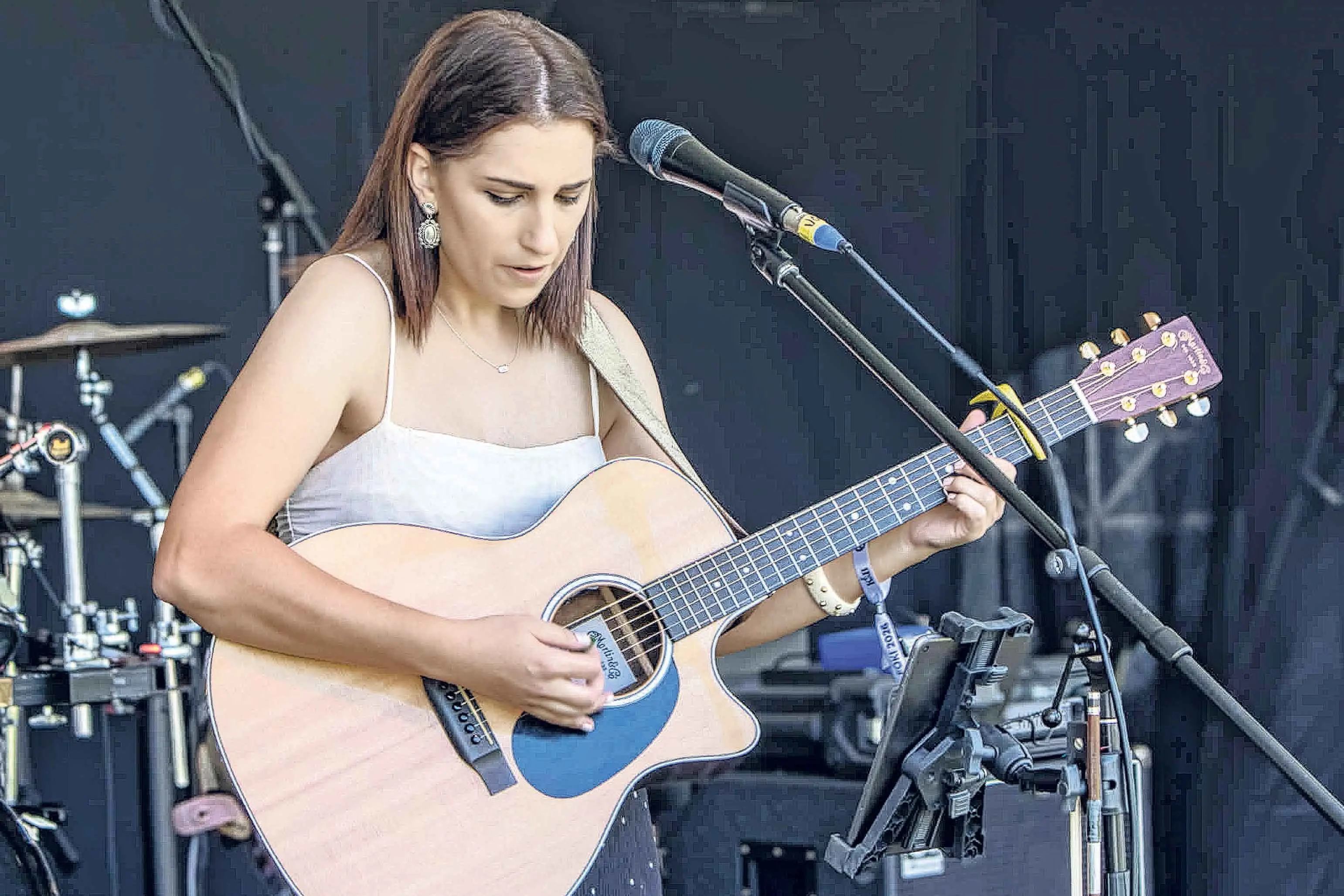
PHOTO
“We always had music on at volume 11 in our house,” Anthea laughs. And why not? Her family was on eight acres at Ammerdown, far from the neighbours. And her mum and dad would constantly be playing Bruce Springsteen, Garth Brooks, Brooks & Dunn, Reba McEntire, Troy Cassar-Daley, and John Williamson.
Her parents did not simply teach their children to hear music. They taught them to listen critically.
“Why does this make you feel something?” Anthea recalls asking herself. “Is it the lyrics? Is it a little piano part that’s not overdone? Mum and Dad taught us how to really listen.”
In their music room sat an 1826 hand-me-down piano. Her father played guitar and sang, her mother sang. Brother Tom joined in on guitar and sister Anna joined in with vocals. At the age of five, little Anthea heard a violin solo on a Garth Brooks track, and asked to learn that instrument.
“It never really got better than that,” she says. Tell that to the kids these days!
At eighteen she went of to study law in Wollongong, and that gave her the space to explore her own musical tastes. And she picked up the guitar, which inexorably took her down the singer-songwriter path she travels today. When time permits.
By day, Anthea works as a lawyer, navigating contracts, deadlines, and high-pressure problem solving. By night, she switches frequencies entirely, stepping into a world of songs, violins, guitars, and emotional storytelling.
For her, the two lives do not clash so much as feed each other.
After a mentally demanding day in law, music becomes both stimulation and release. A different part of the brain lights up.
“Creative Anthea is probably the default setting,” she says. “The lawyer side is the thing I have to rein in.”
Far from feeling like work, songwriting provides its own kind of therapeutic immersion. She describes it as exhausting “in a different way” from legal work, but deeply energising all the same. Like many high-performing professionals, she suspects she is wired to constantly seek stimulation, challenge and movement.
“It satisfies that desire to always be doing something,” says the compulsive fiddler, who also plays with the Stewart Barton Band in Canberra. She’s played festivals including the Neville Country Muster, Festival of King Island, and Tamworth Country Music Festival.
She moves between worlds with unusual fluency. Yet even her contemporary influences such as Dua Lipa and Olivia Dean tend to connect back to older traditions: melody, emotional honesty, musical craftsmanship.
Springsteen still burns strongest.
If she could have written any song in history, it would be Springsteen’s ‘Into the Fire’, his haunting 9/11 elegy told from the perspective of a firefighter ascending the towers.
“It’s excellent storytelling,” she says. “But it’s also universal. People who’ve never lived that exact situation can still feel themselves inside it.”
Another Springsteen favourite ‘The Promised Land’ resonates for similar reasons. “It’s cleverly written without being cringey,” she says. “It’s about standing your ground and having faith.”
Pressed, she settles on the latter as her most favourite song. She mentions Prince’s ‘The Most Beautiful Girl in the World’ before rounding out her top three with ‘Neon Moon’ by Brooks & Dunn, and ‘Edge of Desire’ by John Mayer.
What a discerning starting list to help develop your song craft. Which is probably how her single ‘Heartbreakin' It In’ debuted at #2 on the UK iTunes country music charts.
Other recent titles such as ‘The One That Got Away’ and ‘I Can Handle the Truth’ occupy a slightly bruised, late-night melancholic terrain. Gin-soaked heartbreak songs, perhaps. Lived experience, definitely!
“This is quite vulnerable to admit,” she says, “but I’ve always written to deal with the worst feelings I’m having at the time.”
Then comes the line that seems to unlock the entire interview: “It’s the worst feeling that usually creates the song.”
She pauses.
“I think I’ve probably used up writing that first-person heartbreak perspective for now.”
Instead, she wants to broaden her songwriting lens. More storytelling. More musical exploration. Less formula.
And that formula, she says, increasingly dominates modern music production.
Anthea speaks candidly about frustrations working with producers who chased what they believed the market wanted rather than what she heard in her head. Songs trimmed shorter. Ideas streamlined. Odd little musical detours ironed flat.
“If you heard the demos,” she says, “they’d be five minutes long with a random violin solo and bits that go on too long.”
Now, paradoxically, the rise of AI-generated music has pushed her further toward organic musicianship: “The more AI can create these perfect commercial songs in ten seconds, the more I want to go back the other way.”
Back toward bands. Imperfection. Human feel.
“Maybe people will get sick of hearing rinse-and-repeat songs,” she says. “Maybe the thing that stands out will be the humanity.”
That means trusting her instincts more fully. Playing more instruments herself. Building songs around feel rather than market trends. Letting the music breathe.
“It’s not like I’m Taylor Swift,” she jokes. “I’m not making money out of it anyway. So I may as well make something authentic.”
And crucially, she insists she never wants music to become joyless labour.
Unlike many musicians grinding toward commercial survival, Anthea has the freedom of a professional career outside music. She believes that freedom protects something essential.
“I think if I had the pressure of needing music to pay my rent, it would kill the joy of it for me.”
So she keeps creating on her own terms.
Solo gigs. Band gigs. Acoustic sets. New songs. New directions.
Still chasing that feeling first discovered years ago in a noisy family room at Ammerdown, where that old piano still sits at her parents’ place. All rise — it seems this lawyer has finally found her true voice.
Insta: @Anthea_music_