
PHOTO
There is a particular kind of artist who arrives at creativity early and with theatrical certainty. Then there are artists like Marilyn Hickey, whose relationship with art has unfolded more like a slow-moving inland river: sometimes hidden beneath the scrub, sometimes widening into view, but always moving with quiet determination beneath the surface.
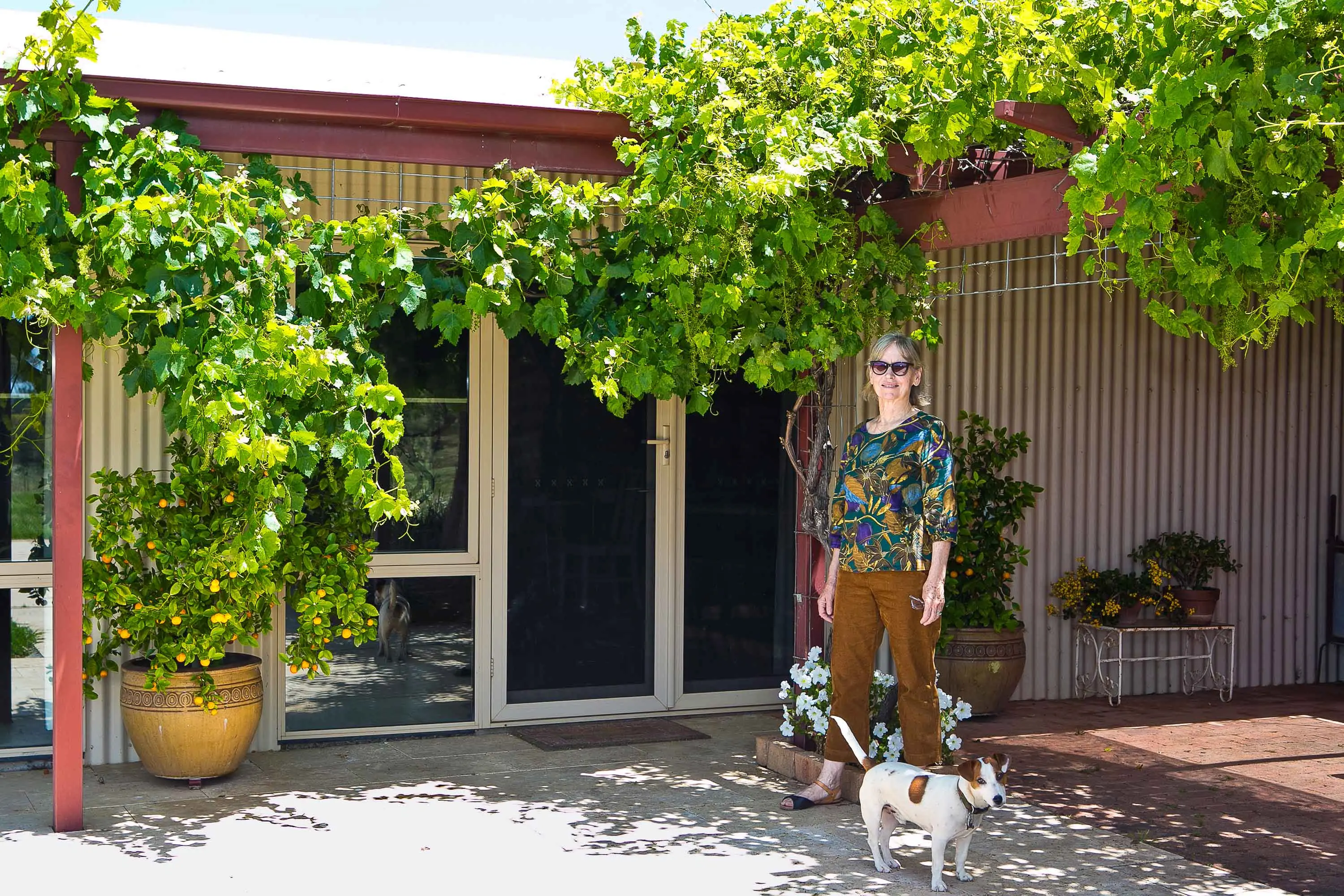
Today, Marilyn works from a large rural property between Molong and Wellington, creating portraits, pastels, oils, lithographs and prints that are deeply human, emotionally charged, and technically grounded. Yet the path to becoming an artist was anything but direct.
In many ways, it began with her mother Margaret.
“Mum was a bit of a waste in that respect,” Marilyn says carefully, reflecting on a woman whose life became defined by the expectations of her era. During the Depression, Margaret left school early to help support the family cake shop business. Practicality came first. Marriage followed. Then children.
Late in life, Margaret admitted to Marilyn that she felt she “didn’t do anything important.”
Marilyn doesn’t consciously frame her creative drive as a reaction to her mother’s unfulfilled life but, when pressed, concedes that possibility. “I think that’s really true,” she says. “I’d be pretty disappointed in myself if I didn’t.”
Alongside that sits the steady influence of her father Tom Plummer, a school principal and language teacher whose philosophy still echoes through her studio decades later: “Do the best with what you’ve been given.”
For Marilyn, art has become precisely that. Not fame. Not rebellion. Not provocation. Simply an attempt to honour a gift by fully using it.
Creativity arrived less through inheritance than ignition.
That spark came at Cowra High School.
Art, she recalls, was hardly treated as a prestigious subject in those days. Students could choose between art and home science. The art room itself was little more than a tiny demountable classroom pushed to the edge of her school, a physical reminder of the subject’s low standing within the education system of regional Australia in the 1960s and 70s.
Yet inside that modest little room, teacher Anne Slattery fired up Marilyn's imagination.
“I had a really good art teacher in first form,” Marilyn recalls. “I think that sort of made it interesting.”
The resources were primitive, the ambitions modest. But something connected. Marilyn still keeps many of the works she created during those school years, including a major piece she laughingly describes as 'The Drunken Pair', a distinctly William Dobell-influenced work featuring rotund, exaggerated figures rendered with all the earnest experimentation of youth.
The paint is now flaking, the paper creased. But those early works remain important benchmarks. Artefacts from the moment the current first began flowing.
Then life got in the way.
Marilyn trained as a physiotherapist in Sydney. Marriage followed. Children arrived. Farms had to be run. Art drifted quietly to the margins.
Until the age of forty-two.
Living near Dubbo at the time, Marilyn enrolled in a TAFE course titled Fundamentals of Drawing. The timing would prove transformative. Again, a teacher appeared at exactly the right moment.
Steven Giese became another major influence, particularly through his emphasis on discipline, structure and artistic lineage. He stressed the importance of mastering “the fundamentals” and studying the great artists who came before. There was little interest in fashionable shortcuts or conceptual gimmicks.
“You have to know the rules before you can break them,” became one of the enduring lessons.
That philosophy still defines Marilyn’s work today. “My work’s embedded in the traditionalists,” she says. Her artistic influences stretch across European masters, Russian painters, the art of Central Asia and the “Stans”, as well as artists she has encountered during overseas travel, particularly in Florence, and Vienna’s Leopold Museum, home to the psychologically charged works of Egon Schiele.
Yet despite this immersion in artistic history, Marilyn has little interest in creating difficult or aggressively political art.
“I don’t think it’s necessary to have a deep message in your art,” she says plainly.
There is no appetite for shock value or activism. Instead, she creates work she herself would want to live with. “Something that I’d like to have on my wall and look at all the time.”
Across oils, pastel, portraiture and printmaking, authenticity matters deeply. “Trying to make it come from me,” she says.
That authenticity is inseparable from her personality itself. Marilyn speaks openly about a reserved upbringing that left her uncomfortable with self-promotion or artistic grandstanding.
“I feel safe if I don’t put myself out there,” the reserved artist admits.
Even now, despite decades of work and considerable technical skill, she remains hesitant about exhibitions and selling. “I’m very possessive,” she laughs. “And I don’t know whether other people will like my work.”
It is a vulnerability many artists would recognise instantly. Marilyn herself finds reassurance in the self-doubt expressed in the letters of Dutch Post-Impressionist painter Vincent van Gogh to his brother Theo. The emotional turbulence, uncertainty and questioning feel strangely familiar.
“The line is an emotional thing, not a technical thing,” Marilyn explains.
That emotional connection perhaps explains why, despite living on a spectacular 3000-acre farm, she has almost no interest in landscape painting.
“You can’t do better than nature,” Giese told her years ago.
The local environment barely enters her work. Instead, she remains fascinated by people. Faces. Gesture. Presence. Human psychology. An intriguing obsession for someone who spends so much of her life in physical isolation.
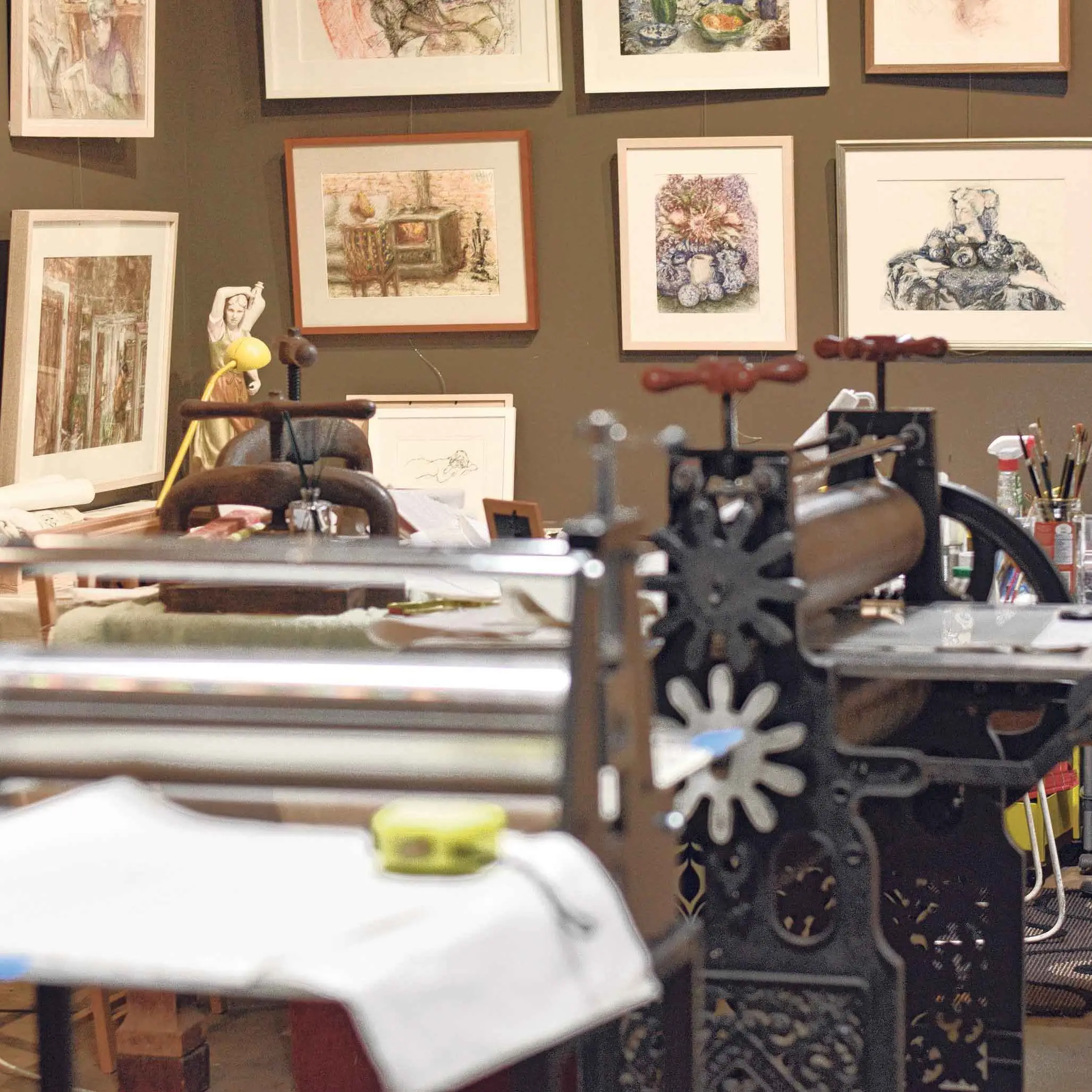
At present, much of her energy is devoted to lithography and printmaking, fields she finds both frustrating and exhilarating. Unlike drawing or painting, printmaking involves indirect, technical processes involving stone, acid, chemicals and etching. There are no spontaneous brushstrokes to rescue mistakes. Precision matters.
Yet that complexity attracts her precisely because it remains difficult.
One of her favourite recent works hangs not in a gallery, but in her son’s Sydney hospitality venue, The Roosevelt. The large black-and-white lino print depicts a glamorous female figure gazing into a mirror, perfectly suited to the venue’s moody Art Deco atmosphere.
Commissions, she says, “fire me up”. The responsibility sharpens her focus. She wants to do her very best for people ... starting with her mum, Margaret, apparently.