
PHOTO
A 12-year-old girl stares at a Reader's Digest book ‘Family Treasury of Great Painters and Great Painting’. The page glows with Toulouse-Lautrec's ‘Jane Avril’, suspended mid-dance at the Moulin Rouge. Beside it: Norman Lindsay's bold Australiana. Cézanne's ‘The Card Players’. Van Gogh. The Dutch masters, their windows alive with light. She doesn't know it yet, but this book will travel through life with her, insinuating itself subliminally into her art.
That girl was Ruth Durose. She's 72 now, and she still has the book.
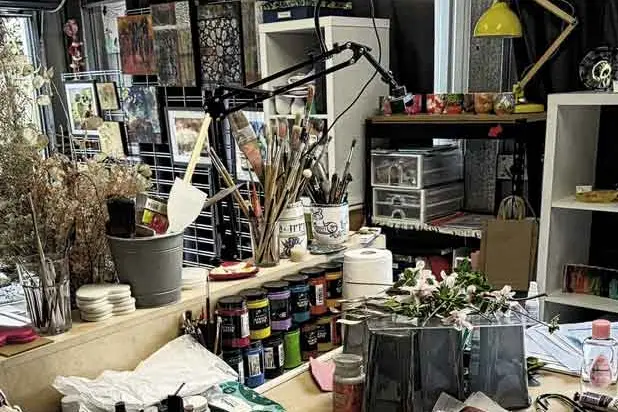
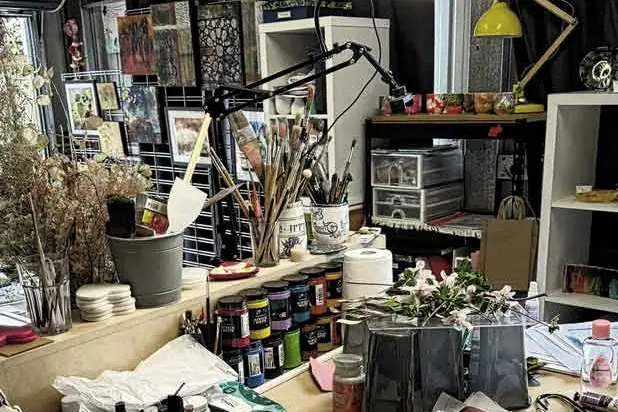
‘There’s never been a time when I didn't want to be an artist,’ she tells me from her Spring Street Studio. Orange born, Ruth left school at 14 years and nine months — three days before the legal threshold — convinced that academia was suffocation. Years of cake shops. Hospitality. A restaurant in Balgowlah, Sydney. Life, as it does, got in the way. And then, somewhere in her 30s, she ran away. Not from art, but toward it. To England. To galleries. To Paris and the Musée d'Orsay, where she finally stood before Van Gogh's ‘Starry Night’ and felt what she now names a "religious experience”— the texture of thick paint layered on canvas, the vivid swirling colours.
Decades later, managing academic support across seven campuses at Charles Sturt University, she realised: the girl who hated school had spent thirty years trying to keep other kids in it.
The contradiction dissolves when you understand the flipside of her ADHD, diagnosed just last year. "It's been a double-edged sword," she says, matter-of-fact. Hyperfocus. Resulting in 12-14-hour days creating with barely a break for a cuppa. Observational skills heightened past what most people notice. The ability to absorb everything at once — form, light, shadow, colour, the bigger view — and miss nothing.
As a mature uni student, she retreated from a psychology degree after a year (statistics, she says, would undo her). Switched to English literature and history. The breakthrough came when she realised something that now animates everything: "If you study history, art, literature at same time, you get the whole picture." Not separate disciplines. A braid. A way of understanding why paintings were made the way they were, why some were controversial, why certain palettes — ochres, browns, yellows, the warm earth tones of Cézanne — call to her across the decades.
When COVID arrived, Ruth jumped at her dream. "Increasingly I wanted to chase my dream," she says. She set up Spring Street Studio. For three years, she worked in photo media, channeling thousands of photographs taken across the world into experimental layers. Then she discovered gel printing. There’s an excited tone in her English-tinged accent when she says these words.
The attraction was immediate: "instant gratification." A process that appealed to the impatient architecture of ADHD. Roll paint. Press. Lift. Know in seconds if you've succeeded. But gel printing is also a fickle, temperamental, and moody collaborator. "Too hot, it won't work. Too cold, it won't work. Press too hard, it fails. Press too lightly, it fails. The planets need to align before you can take a print transfer." Yet she persisted. Now, three years in, she's integrated it into mixed media — photographs becoming transfers, textures layering into something neither photographic nor purely painterly.
"Colour and texture are the main things for me," she says. And they are everywhere in her work now.
The Outback claimed her. Joy Engelman, the internationally acclaimed Australian painter whose work travels to Venice and beyond, became mentor and mirror — another artist obsessed with the painted desert, the brutal beauty of salt lakes, the red dust of remote stations. Ruth and her sister headed out on a five-week road trip through Central Australia, came back and created a mixed media work called ‘Somewhere in the Middle of Nowhere’. With Rust. Maps. A compass marking dead centre. Highly textured desert rendered in paint and pastel. She'd half expected to bring it home and hang it on her wall but it sold on the opening weekend.
She's found her tribe, too. At Millthorpe Creative Arts. And through her workshops. Not because she's teaching them to chase success, but because she understands something about adult education (her postgraduate qualification) and the fact that "you can take the teacher out of the classroom, but you can't take the classroom out of the teacher." Her students call it addictive. Many come back for more.
Now comes the full-circle moment.
She pulls out the Reader's Digest treasury and looks at the paintings again. She sees something she couldn't articulate as a child. The texture in Van Gogh. The palette of Cézanne. The boldness. The way those painters loved the surface, the mark, the visible gesture. It's in her work now. Not copied. Absorbed by osmosis. Subliminal. A visual inheritance that travelled from a 12-year-old girl's astonishment straight into her hands, waiting decades for her to be ready to receive it.
She's not done. Not close. She's preparing a body of work for exhibition at Millthorpe in November— a combination of 2D prints, mixed media, and 3D paper clay pieces. All of it following that Central Australian road trip. Different zones mapped by colour and texture: the tall eucalypts of Hay. The sand formations of Mungo. The pink salt of Lake Eyre. As you walk around the room, you walk the country.
At 71, she's entering what she calls an exciting experimental phase. Everything is possible. The gel plate is still yielding secrets. Paper clay opens new dimensions. The Outback speaks in colours she's learning to hear.
She sits in her studio — "my happy place” — still thinking about that girl with the book, still asking the same essential question the book posed: What if you could learn to see the way these masters saw? What if you could let texture and colour do their work?
Sixty years later, she's still creating colourful answers.
springstreetstudio.com.au Insta: Ruth_springstreetstudio