
PHOTO
Anyone who thinks it's too late to start should take note of Australian artist Rosalie Gascoigne.
The renowned artist, best known for her vibrant assemblages of found objects such as street signs, didn't begin her career until the age of 57.
Yet New Zealand-born Gascoigne rapidly became a celebrated artist who re-envisioned the Australian landscape, before her death in 1999 at the age of 82.
A major retrospective at the National Gallery of Australia in Canberra brings together 80 of Gascoigne's most significant works on the land she called home for more than half a century.
They include some of the last works she made such as Metropolis, and the 10-panel installation Earth, as well as the recent NGA acquisition Feathered Chairs, from 1978.
Gascoigne made her art in the Canberra region, collecting materials around Lake George and the Monaro plains – not to mention from many items found at local dump sites.
Inspired by clear skies and brilliant light, she would find items weathered by use or exposure, such as corrugated iron, fencing materials, long grasses, and old enamelware.
The NGA's head curator of Australian art, Deborah Hart, remembers Gascoigne as an intriguing artist whose artistic vision was formed decades before she started exhibiting.
"She thought deeply about her work... and was very clear in her thinking. She didn't suffer fools," Dr Hart told AAP.
Dr Hart was able to access letters the artist wrote to family overseas, to glean fresh insight into her artistic process.
"It's a bit like prospecting for gold, these little nuggets in between the day-to-day things... that just shed such light on her thinking and feeling at the time of her exhibitions," she said.
Gascoigne wrote to her son Toss in 1973 about cluttering up her house with three carloads of finds that had yet to be used, including 22 bee boxes from an apiary.
"Lovely faded pink & green paint on some of them & lots of good greys. Ultimate fate unknown of course."
After making art out of beer cans from Hobart's Cascade Brewery, the artist wrote to thank the company in 1978.
"The first beer can I ever used was a faded pink Cascade can, and the work in question... was bought by the Australian National Gallery... I must congratulate you on having one of the best designed beer cans in Australia."
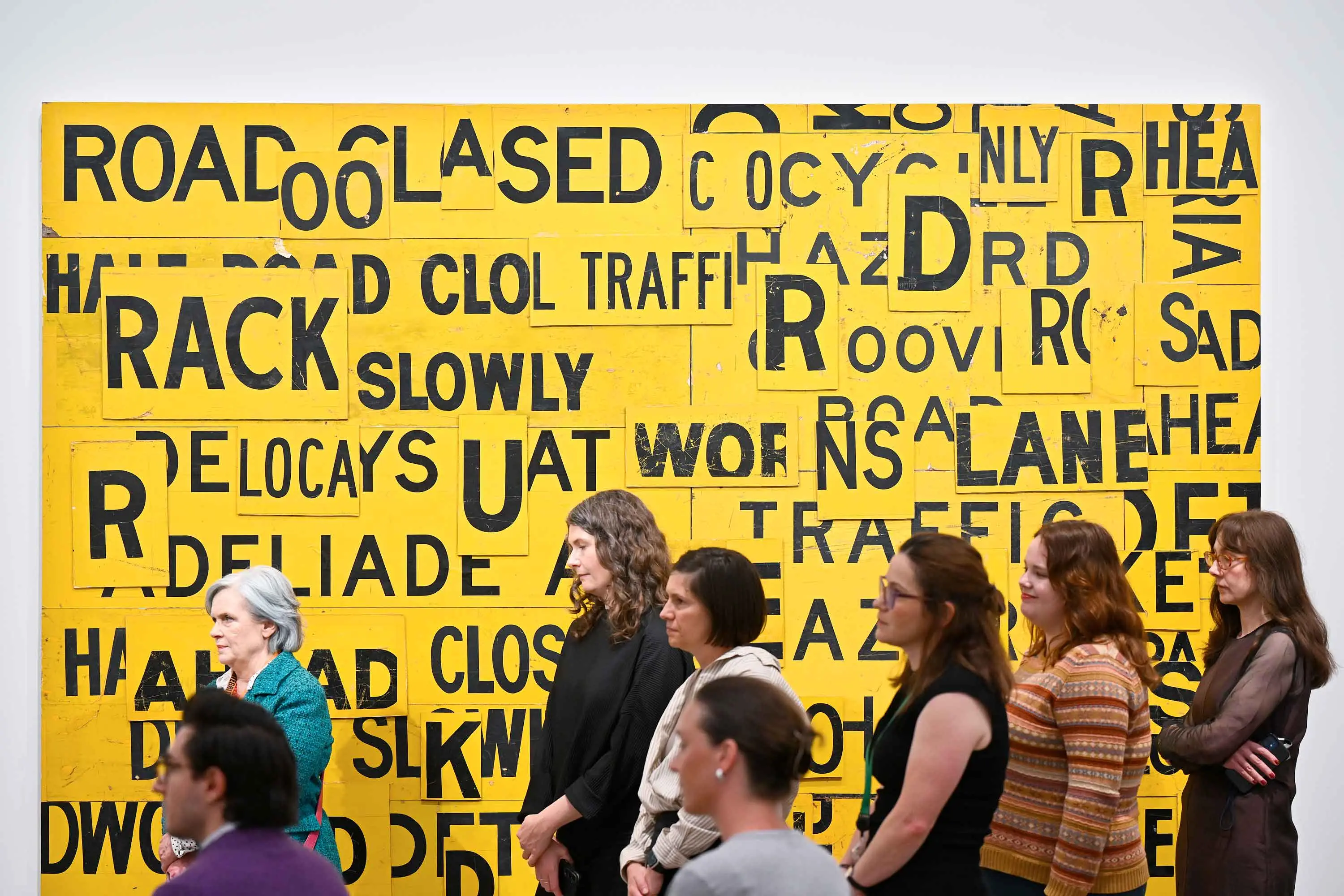
Gascoigne's most easily recognised works are her assemblages of yellow and black road signs, but Dr Hart wants gallery-goers to appreciate that there's much more to the artist's output.
There's a room devoted to Gascoigne's love of luminosity and dry grasses, and a section for assemblages constructed from rusted enamelware.
Rosalie Gascoigne is a free exhibition which runs from Saturday until February 14, 2027.