
PHOTO
A record-breaking earthquake near one of Australia's biggest gold mines has been felt along the east coast, with locals describing explosions, shaking and rattling.
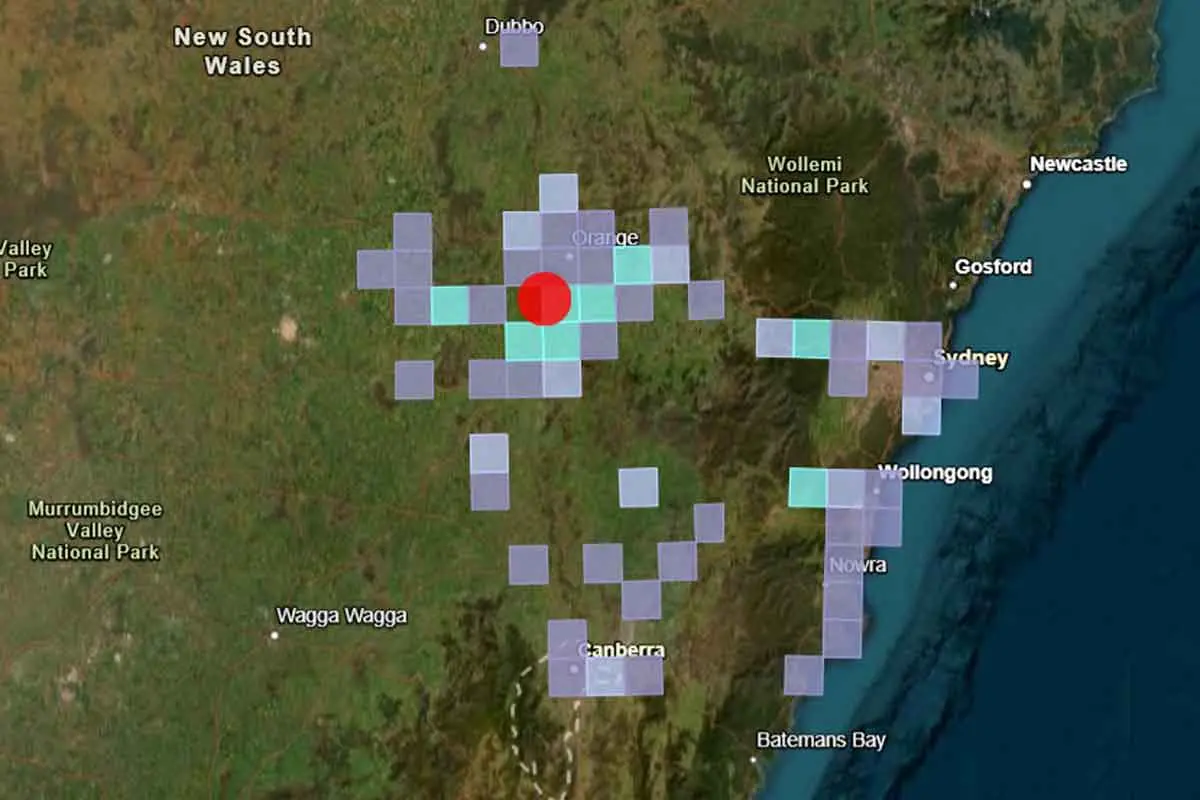
The 4.5-magnitude quake hit at 8.19pm AEST on Tuesday at a depth of 5km about 30km southwest of Orange in central western NSW.
Geoscience Australia's mapping shows the quake struck east of Newmont's Cadia gold mine.
Senior seismologist Phil Cummins said only five quakes above 3.5 magnitude had been recorded within 50km of the site since 1977.
A 4.3 magnitude tremor struck in 2017.
"It's the largest earthquake ever felt in that area," Dr Cummins said.
More than 2000 people logged "felt reports" with Geoscience Australia, with strong shaking reported near Orange.
Weaker tremors were felt 350km away at Batemans Bay.
Blayney Shire mayor Bruce Reynolds, who lives about 12km from the epicentre, said the quake rocked his house.
"It was like an explosion under the house," Mr Reynolds told AAP.
"My biggest concern when it happened was the underground workers at the Cadia operation, it's a huge underground mine."
A statement from Newmont said all underground workers were accounted for and safely returned above ground.
"There have been no reported injuries," the statement said.
"The safety and wellbeing of our people remains our highest priority."
Underground operations have been paused while specialist crews conduct inspections.
Mr Reynolds said the quake felt much stronger than in 2017, which "rolled" in and out.
"This one was a fairly substantial earthquake," he said.
Many locals compared the sensation to the rumble of a freight train or a plane flying low.
Blayney's deputy mayor Rebecca Scott was sitting at her desk working when she felt a jolt.
"I looked over and my (pedestal) fan was rocking backwards and forwards," Ms Scott told AAP.
Being close to a busy intersection, Ms Scott said she first thought the noise was traffic.
"With the first jolt, I thought 'had a truck gone over?'," she said.
The mayor said there were no reports of damage, but council workers were checking roads, bridges and culverts.
The NSW government had already offered disaster support if needed, Mr Reynolds said.