
PHOTO
Australians have shown high interest in IT jobs during 2026, ahead of work in nursing, aged care or construction, but the strongest prospects for jobs growth are in health and care, according to a federal body.
Jobs and Skills Australia (JSA), the Australian Government body which provides advice on current, emerging and future workforce, skills and training needs, projects the health care and social assistance sector will employ almost 542,000 more people by May 2035, up 22.9 per cent from May 2025.
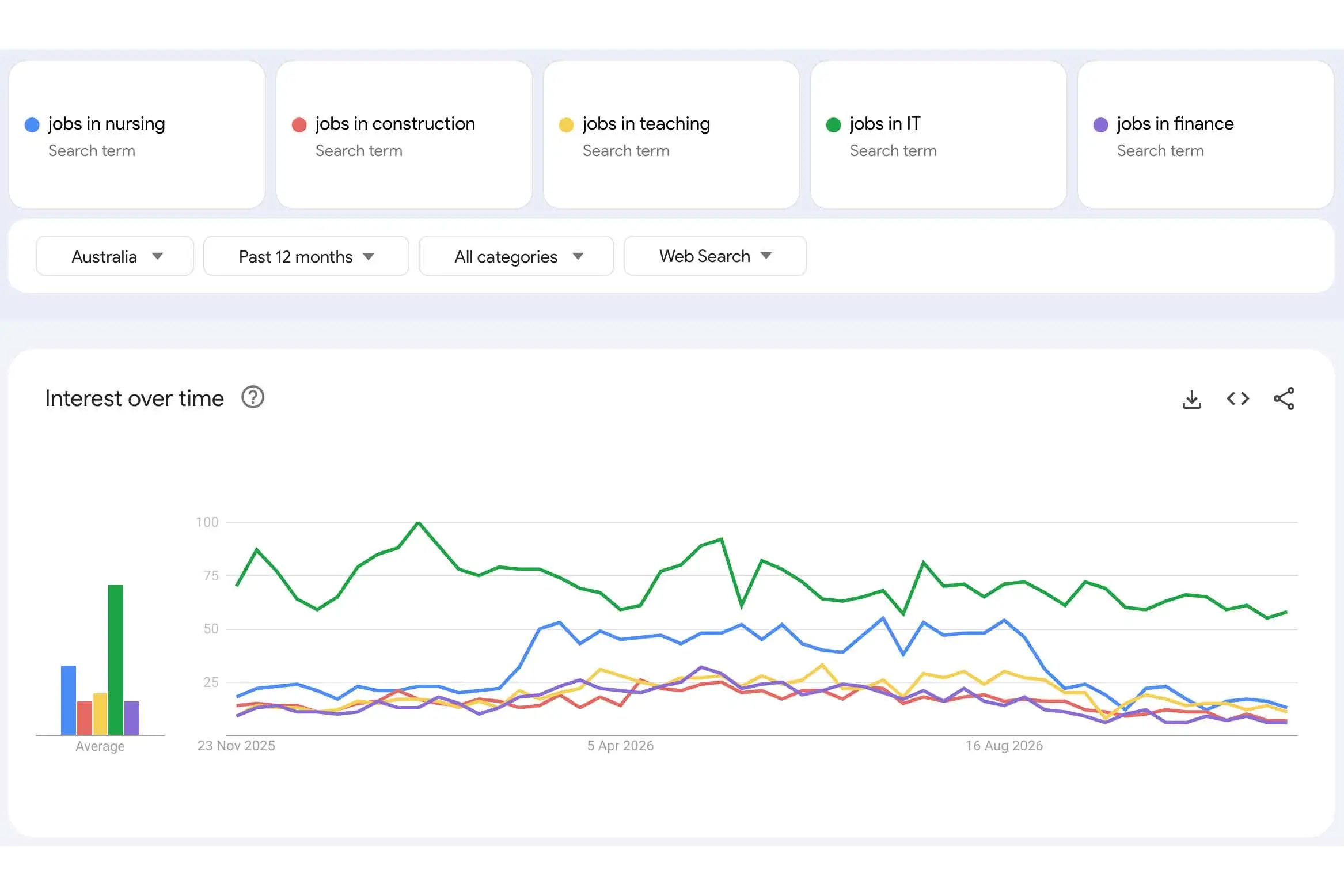
However, the careers people are researching most and the careers that have the strongest long-term prospects are not one and the same. In a year when the impact of Artificial Intelligence on jobs has been a hot topic, the jobs that Australians are researching most are in Information Technology (IT), according to search interest data from Google Trends. "Jobs in IT" has been the clear leader during 2026, followed by jobs in nursing and aged care.
Search interest in IT jobs has also been reasonably constant during the year, compared to health and aged care work which started the year lower, picked up during the six months from March, before easing off again, Google Trends data shows.
For those looking to enter IT, competition can be stiff. A JSA analysis released in September found about one in three IT employers that recruited in 2025-26 received at least 20 applications per vacancy. SEEK also reported that ads for information and communication technology jobs fell 1.7 per cent from September to October. In other words, the number of vacancies is falling slightly, while competition for those positions is high.
The outlook is brighter for some roles. The federal agency’s Australian Jobs 2026 report projects the number of software and applications programmers will grow by 15.7 per cent in the five years to May 2030.
Where the jobs are
Health and care offer opportunities for people with different qualifications. Employers struggled to recruit registered nurses in 2026, and JSA expects the number of aged and disabled carers to grow by 10.7 per cent in the five years to May 2030. One way into aged care and disability support is through the Certificate III in Individual Support, which includes at least 120 hours of practical work.
Construction and education are also worth a look. The 2026 Occupation Shortage List found ongoing shortages in areas including construction, electrical trades and early childhood education. JSA expects employment in construction and in education and training to grow by about 12 per cent each between May 2025 and May 2035. Those projections are based on past trends and do not yet factor in how generative artificial intelligence (AI) might change the job market.
Digital skills can help in a range of careers. The University of Sydney’s 2027 Skills Horizon report identifies working with new technology and adapting to AI as important skills for leaders, alongside working with people from different backgrounds and solving complex problems.
“You won’t always have all the answers, but you can still take the next step, learn and adapt,” Telstra chief executive Vicki Brady said in the report.
Is it too late to change careers?
If jobs are becoming harder to find in a line of work, age alone is a poor reason to rule out a change. Age bias can make the search harder, however. A 2025 survey by the Australian Human Rights Commission and the Australian HR Institute found one in five HR professionals said their recruitment practices disadvantaged older workers.
Before signing up for a course, look at local job ads to see which skills you already have and what qualifications employers ask for. Work out how long training would take, what it would cost and whether you could manage on a lower income while studying or starting a new job. If the course includes a placement, check how it would fit around work and family.
The federal government’s free Career Transition Assistance program helps eligible people aged 45 and over identify skills they can use in a new job and tailor their applications.
Aside from jobs in IT, the Google Trends data shows search interest in health and aged care is high, followed by jobs in teaching, then construction and finance.
* This content is part of a paid partnership with Google to promote Google Trends.