
PHOTO
William Bede Melville is a name few would know today, but at one time he was the most famous journalist in Australia.
Billy, as he was familiarly known, was born in Molong and began his journalistic career at the 'Australian Star' around 1890, before joining the staff of the 'Melbourne Age'. Over his career he contributed to scores of papers in Australia and internationally, often under a range of pseudonyms.
Billy had strongly held political views and was an ardent protectionist. He stood three times to represent Molong in the state legislative assembly, once for the federal seat of Calare and once for Randwick, but each time unsuccessfully.
For several years, he was the chief secretary to Protectionist party leader Sir George Dibbs but his “pronounced views on political questions” frequently clashed with those of Dibbs and other party members.
But it was a clash of a different type that stuck in the memories of those in political circles: Billy was one of three combatants in a King Street bar punch-up, the other two being members of the legislative assembly.
A member of the Sydney Bohemian set, Billy was described by the artist Norman Lindsay as “a small, very upright man, with a trenchant, resolute address, and he wore a frock-coat, a handle-bar moustache, and a wide-brimmed high-crown hat, which figures in my visual memory of him; an unforgettable one."
At the outbreak of the Boer War, Billy set off for South Africa, working as a correspondent for the 'London Daily Express'. It was here in 1902 that he broke one of the most sensational and widely republished stories of his career: Dan Kelly, the younger brother of Ned Kelly, along with fellow gang member Steve Hart, did not die at Glenrowan, but were alive and fighting the Boers in South Africa!
As far as most in Australia were concerned, Dan Kelly and Steve Hart had perished during the shootout with police at the Glenrowan Inn in 1880, their bodies severely burnt in the fire that destroyed the hotel.
With the public’s interest piqued by the news of their survival, Billy wrote a detailed follow-up to his tale for the 'Australian Star'.
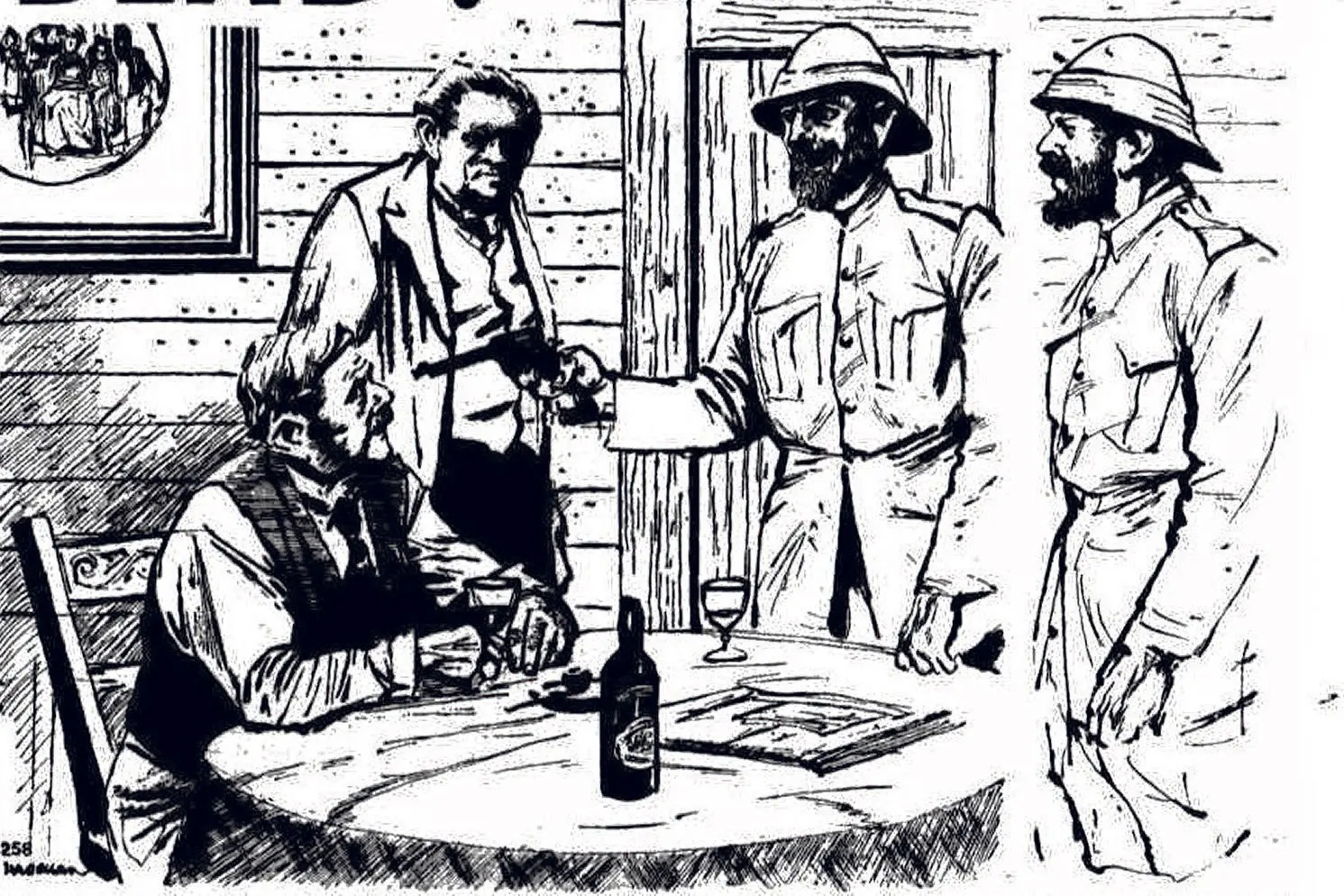
He said he was at first dismissive of the story, told to him by a soldier in a military camp in Pretoria. Then late one night, he was brought face to face with “Dan” and “Steve” in his tent and, over a bottle and a pipe of tobacco, they explained to Billy how they got away.
The charred and unrecognisable bodies found were those of two tramps, not known to be in the hotel, explained “Dan”. He and "Steve" had put on police uniforms and crawled through bushes away from the hotel, turning to fire on the building to add to the disguise.
“But we banged away at the blooming pub more'n any of them,” “Dan” said. “The traps (police) came from a hundred miles around, and only some of them know'd each other. They didn't know us, anyhow.
“We worked back into the timber, and got away. Well, we got to a friend's shepherd's hut... He found us clothes and money. We got to Sydney, and shipped to the Argentine… A few years ago we crossed to South Africa. The war broke out, and being out of work we went to the front.”
Suddenly worried about being turned in to the authorities, “Dan” put a gun to Billy’s head and made him swear he would not reveal their identity until they were well gone from South Africa.
The story was widely decried as fiction by rival newspapers, which produced columns of evidence to contradict the tale.
But the 'Australian Star' editor doubled down on Billy’s story. A Melbourne businessman, the paper reported, had walked into the editor’s office and declared that he had known the Kellys well years ago and had seen a soldier the spitting image of Dan stepping off a boat from South Africa in Sydney!
While stories of Dan Kelly and Steve Hart surviving the Glenrowan shootout were being whispered even before the hotel's ashes had cooled, Billy Melville’s report gave them new life in the 20th Century.
Strangely, Molong was once again tied to the tale when, in 1919, an old station hand in the district revealed that he was none other than Dan Kelly. His story of survival was nearly identical to that reported by Billy although India, rather than “the Argentine”, was given as their escape destination.
It was in India that they enlisted for service during the Boer War and had returned after, Molong’s “Dan Kelly” revealed.
Steve Hart, he said, had drowned in Calcutta Harbour in 1917, and Kelly had come back to Australia to visit his old haunts. Running short of funds, he had then taken up work in Molong.
The old station hand was the same recorded height as Dan, and efforts to trip him up in his story were apparently unsuccessful.
But, as more than one sceptical journalist pointed out, if he was hard up for money, why did he not go see his mother or other living relatives, who would no doubt be happy to help?
It turns out that the Molong station-hand was not the only one claiming to be Ned Kelly's brother at the time. In fact, enough itinerant workers had revealed themselves to be Dan Kelly that it was even used as an advertising gimmick for Victory Rum.
“Quite a number of men have claimed to be the real Dan Kelly but facts prove that they are only substitutes for the real Mackay,” read one advertisement in the 'Orange Leader'.
“Substitutes for the real Dan — like substitutes for Victory Rum — must eventually fail to ‘Make Good.’ Victory Rum needs no armour plate to protect its quality.”
Periodically throughout the following decades, newspapers would run stories of Dan Kelly being alive in one place or another. Even today, many claim Dan Kelly lived a long and eventful life and is buried in Ipswich, Mount Isa, or some other outback town.
But these tales are given little credence by historians.
While details in these other “Dan Kelly” stories vary, interestingly, most include the account of his having fought in the Boer War, a story that seems to have originated with Molong’s Billy Melville.
William Bede Melville died in 1914 after an acute attack of pneumonia. He was just 46 years of age.