
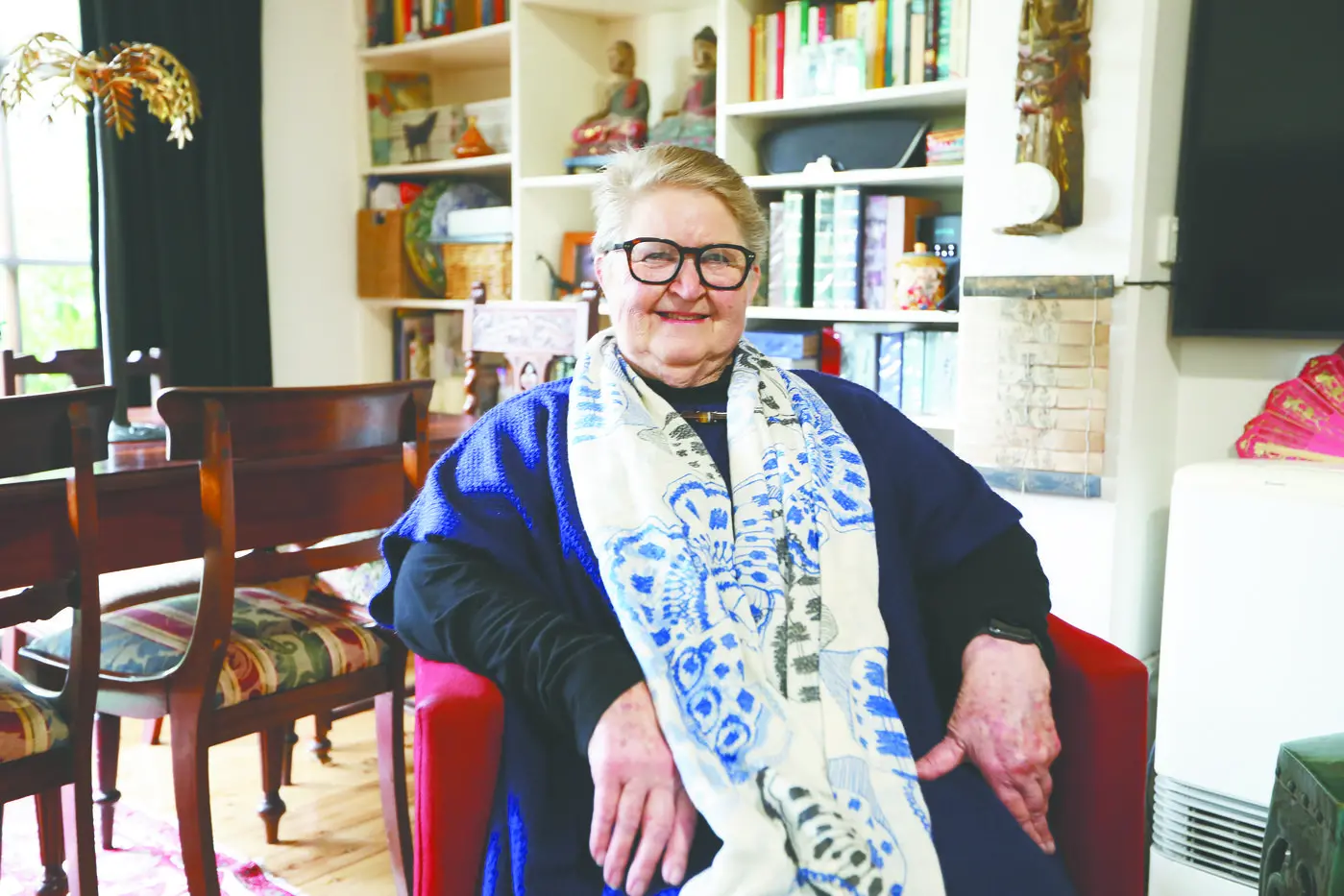
PHOTO
One night in January, retired nurse Clair Thompson had just gone to bed when she experienced a sudden ringing in her left ear. Finding the sensation uncomfortable, Clair switched on the television to distract herself only to discover she couldn’t hear a thing.
“Within a space of half an hour, I had suddenly lost my hearing completely in my left ear,” said Clair, who had unfortunately lost hearing in her right ear three years prior.
“It was very frightening,” Clair said. “I didn’t ever think I’d lose the hearing in this ear. I was sort of quite comfortable learning how to just hear out of one ear.”
What Clair experienced is known as sudden sensorineural hearing loss. While many of those affected regain their hearing with prompt treatment, unfortunately for Clair that wouldn’t be the case.
Over the following days, Clair’s situation was brought home to her by the difficulty she faced being unable to make telephone calls and communicating only by writing or texting.
“I had so many doctors’ appointments. There were such a lot of phone calls to make for X-rays, for pathology, for ENT, but I couldn’t hear a thing on the phone, I couldn’t hear a thing that anyone said to me,” Clair said.
“It was an incredibly tough week because I realised just how many things you need your hearing for. All these things I had to do and I couldn’t do them. I was reliant on other people to help me.”
But much more than these day-to-day inconveniences, Clair’s deafness brought on a sense of isolation, even depression, as she began to realise that her social interactions would no longer be the same.
“You realise your friends will probably drop off because you know they can’t ask you to certain places. Say, going out for coffee, you’d just sit there smiling sweetly and saying nothing,” Clair said.
“You think, will they still want to play cards with me because I can’t hear what they’re saying? Or dinner at someone’s place; no one really wants to have someone yell at the table all the time and everybody’s yelling back.”
Clair lost confidence in her ability to drive and also felt less steady on her feet, which meant she stopped going for her regular walks.
“I’d withdrawn into my own shell and my
own little comfort zone here in this house,” Clair said.
“And then I saw Dr Aydin Mohammadi. He said, ‘You are profoundly deaf.’ He was full of empathy and then he said, ‘But there is light at the end of the tunnel, I can promise you. You’re an excellent candidate for a cochlear implant’.” Clair was assessed, and her surgery approved but, when given a choice of hospitals in Sydney or Newcastle, she was insistent that it be done closer to home.
“They said, ‘No, it can’t be done in Orange. It’s not possible.’ And I thought, well, it is possible. My saviour is going to do it for me. And he did!”
On August 12, Clair received her cochlear implant at Dudley Private Hospital in Orange, the first time the surgery had been done outside of a major metropolitan hospital in NSW.
Otorhinolaryngologist Head and Neck Surgeon (ENT) Dr Aydin Mohammadi, who performed the surgery said much of the groundwork to allow it to be done locally had begun prior to Clair’s case, but she provided the impetus for them to push the process ahead more rapidly.
“As you can imagine, it takes a lot of work in the background... all the safety regulations that have to be in place to ensure that I am actually qualified to do that operation and we’ve got the anaesthetic support and theatre support and nursing support to be able to do it all,” Dr Mohammadi explained.
“But without Clair essentially saying that she didn’t really want to have an operation done away from home, that was what really brought us together and say... How do we make it happen? And all the parties came together as a result of that.
“We’re very, very lucky in Orange that we have the facilities that we do and the nursing team as well as the anaesthetic teams that allow this to happen, because, honestly, without them I’m just a technician really.
What I do is a very minuscule part of the whole thing.”
The demand for cochlear implants is quite high, said Dr Mohammadi, whose goal now is to be able to provide them to public patients in Orange.
“That will be a much more rewarding experience for me than anything else I’ve done in my life,” he said, adding that there are many hurdles to overcome.
“The main issue through the public system is that it is very oversubscribed. So we have a lot of patients waiting for surgery and minimal operating time – and a lack of staff, including nursing staff and a lack of theatres, so physical space, to be able to do an operation such
as that.
“And the only way for that to happen is by increasing the amount of funding to the public health system in the Central West, to allow surgeons such as myself to be able to do those operations in the public sphere.”
For Clair, being able to have the operation in Orange, and at Dudley Private Hospital where she had worked as a nurse for 25 years, was a big comfort in what was a traumatic period of her life.
“If you go to Sydney, you’ve got all the added anxiety of a relative or whoever is taking you, they’ve got to get accommodation. You’ve got to work out, what if you need anything? Who’s going to get it for you? You’re more concerned about your house and your pets and all those things,” she said.
“Whereas, if you’re in your own country town, it’s just a little bit more bearable.”
The day her implant was switched on was an emotional one for Clair, who had not realised just how depressed she had been over the past six months.
“It was very emotional. It was sort of the coming together of everything... the culmination of so much anxiety and questions: I had questioned whether I should have it done or not, but I recognised that there was no option. It was either a life of me going downhill and into a nursing home, or I could have this done and see what happened.
“And certainly the difference in me psychologically is huge, it’s as if I suddenly took happy pills after it was done.”
While Clair says there are times she doubts she’s making progress, her hearing is improving and will continue to improve as her brain codes hearing regions to adapt to the implant.
“We were in the garden the other day and my daughter said something to me behind my back, and I heard it!” Clair said.
Clair’s operation, on August 12, happened almost 40 years to the day since pioneering surgeons – Professor Bill Gibson and colleague Dr Barrie Scrivener – implanted the very first multi-channel cochlear implant in NSW.
In a remarkable coincidence, Clair said the day also happens to be the birthday of the late Dr Scrivener, who was an old family friend.
“His daughter wrote to me – who is part of our extended family, as Barrie was – and said, ‘I just am so incredibly proud! Little did Dad think that this would ever happen outside of a metropolitan area. He would have been so proud of the fact that it was being done in Orange.’”
That Clair put her trust in him to do this operation was an incredible privilege, Dr Mohammadi said.
“It was really quite a big deal for me. I’ve done lots of cochlear implants in the past and I’ve done plenty of kids in the past, but it was different because I had known Claire and I’d sort of seen her through that journey as well.
“What ends up happening in some of the major hospitals is you don’t have that direct connection with the patient, whereas here I feel like I am their doctor and I’ve seen them through that process.
“I think that’s the point of difference of having someone do it locally for you.”