
PHOTO
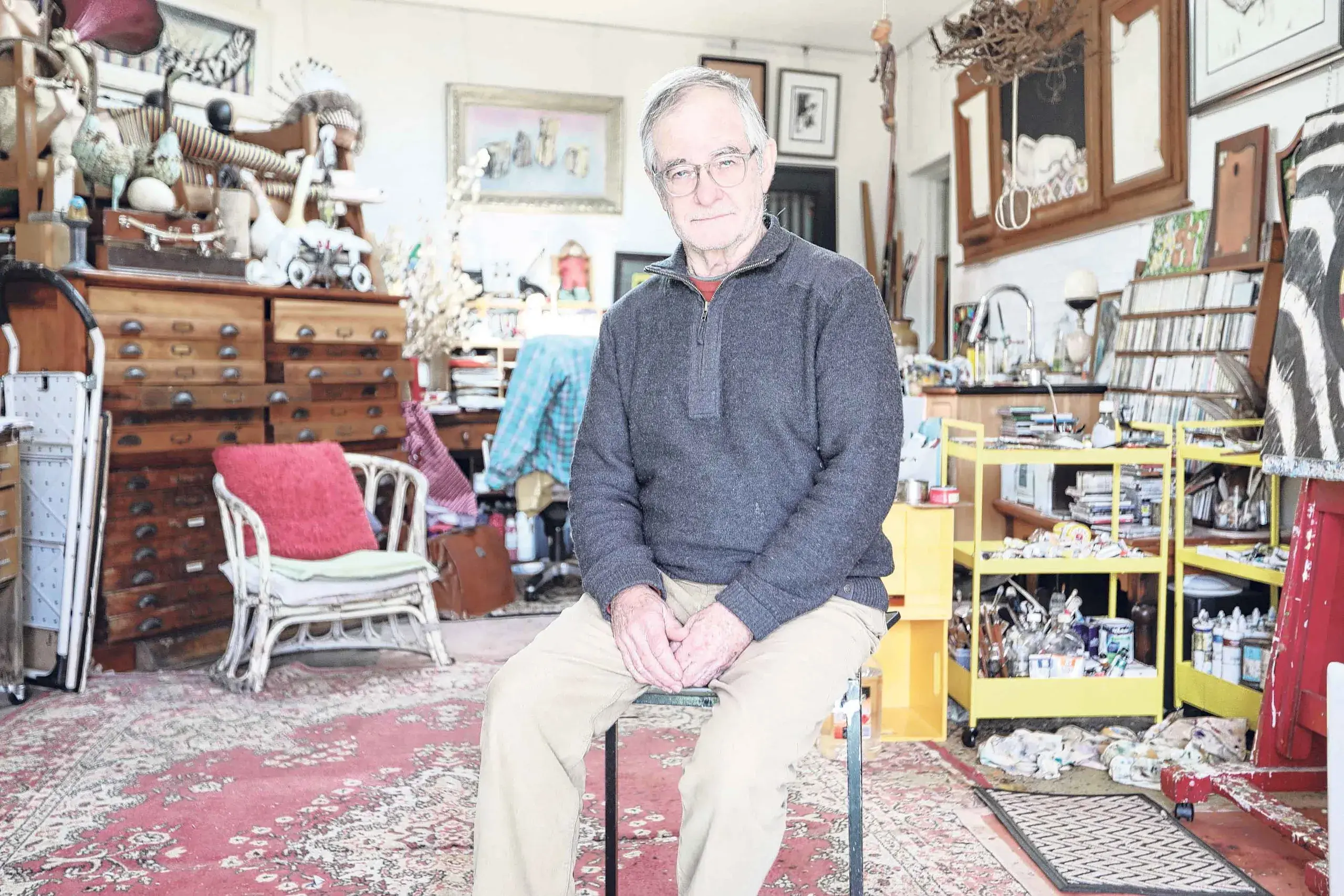
“I've got no idea how I ended up in Australia. I could never have conceived of coming here when I first set out in my life,” says South African born painter and sculptor Victor Gordon, sitting in the living room of his home in Orange.
The room is a visual feast, with the walls adorned with artworks and artifacts from his African homeland. Large stretched hide drums and wooden spears fill a nearby corner, while a small sculpture sits in the available space on a nearby cabinet shelf. In the next room, there are large bookshelves with an eclectic collection of histories, novels and philosophical treatises.
“People often ask me why did you come to Australia? And I say, I actually wrote ‘Austria’ on the form, and I make a joke of it,” he laughs. “Humour has got me a long way, and it sort of permeates my artwork as well.”
While there is plenty of humour in Victor’s art, the subject matters he delves into are far from funny and often uncomfortable. But that is exactly the point, Victor will tell you.
Growing up in Johannesburg at the height of Apartheid, Victor says that at a very young age, he was acutely aware of the injustice faced by so many in his country because of the colour of their skin.
It was through art that Victor discovered a way of fighting back.
“Becoming conscious of what was going on in South Africa as I was growing up, I became more and more politicised in terms of understanding the rights and wrongs of what Apartheid was all about,” says Victor.
“So I eventually ended up starting to make artwork about Apartheid. And of course, it wasn't at all popular with the ruling government at the time… and I got into a bit of strife about that.”
In 1987, Victor came to Australia, a self-imposed exile from South Africa who saw it as his duty to let the world know what was happening in his home country. He enrolled in a Graduate Master of Visual Arts programme at Sydney College of the Arts, and continued to build on his growing body of anti-Apartheid work.
“It was important to me, I felt it was a contribution I could make to what we called 'the struggle' to simply make this body work and then put it out there to a non-South African audience to spread the word, as it were, of the horror of what was actually going on in South Africa,” he explains.
“And I was quite surprised at how little people knew about Apartheid in Australia.”
Last year, in what he said was the pinnacle of his career, Victor had a painting acquired for the permanent collection of Johannesburg’s Apartheid Museum.
“That was the major accolade of my life, really, to have that acknowledgement,” he says. “That the work that I did then will be seen, and people will be able to respond to the little contribution that I made.”
And earlier this year, another of his sculptural works was chosen to represent South Africa's Constitutional Court Collection in Johannesburg at an exhibition at the Zeitz Museum of Contemporary Art Africa in Cape Town.
The exhibition celebrates the dedication of retired Judge Albie Sachs' unique concept of combining art and justice.
But strangely enough, says Victor, the piece chosen, titled ‘The Essential Archbull’, is actually a scathing attack on the Australian art scene.
“Shows like the Archibald are slightly anachronistic in the sense that they're creating a set of mugshots of really important people. In world art terms, it is way past its used-by date,” says Victor.
“Just portraiture for the sake of portraiture… and it has been turned into a circus - a very lucrative circus.”
Art in Australia is not taken seriously, says Victor, but seen more as decoration or entertainment, neither of which appeals to him.
“People don't see that the visual arts can actually be a meaningful tool of political debate, but I do,” he says.
“We tend to go to more light-hearted stuff that borders on entertainment rather than things that make us think. My feeling about art is that I see it as a language that I can use to actually pose issues and questions that are meaningful to me… and I don’t hold back!”
Of course, it’s not the most lucrative path for an artist in Australia.
“If you make the type of art I make, you're going to realise that you're not going to be commercially successful,” says Victor, who is not one for regret.
Four years ago, Victor was diagnosed with pancreatic cancer and was lucky to survive the surgery. The experience, he says, has made him determined to make the most of every day.
“I suppose my health is... How can I put it? I know my days are numbered, but you know, I've had an incredible life, I have!” he says.“So many people have regrets, and they think, I didn't do this and I should have done that… I've made the most of the time that I've had.
“And that's what I believe you need to do, it's almost like a responsibility: make the best of what you've got left of your life.”