
PHOTO
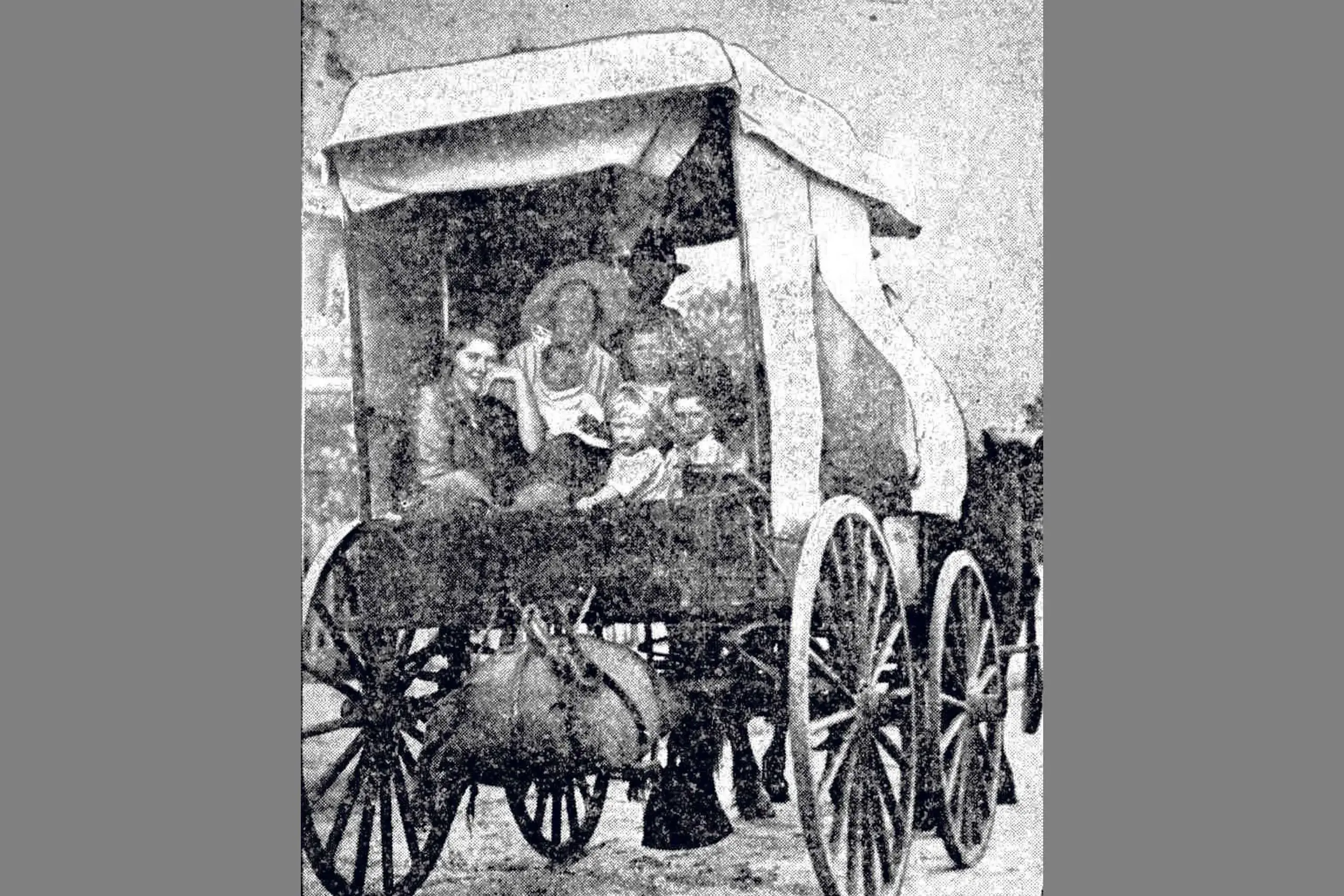
Looking back at the early days of motor transport, it is interesting to note how quickly people embraced the new technology. Within just a few years of the very first cars being brought into Australia, there were thousands on the road. So commonplace was motorised transport by the early 1920s, that the journalist of the 'Sunday Times' thought it noteworthy to include the following photograph and write-up on a family from Manildra and their "antiquated" mode of holiday transport.
From the 'Sunday Times', 26 February 1922:
"It is not true that all farmers who have made good buy motor cars or travel first-class to Sydney when they have laid down their ploughshares, turned out most of their horses, closed up the homestead, and set off for a holiday. The accompanying picture depicts a farmer and his family on the trek over the Blue Mountains to Manildra, thirty miles from Orange. They were on the way through Faulconbridge, on the Great Western Road, when the photograph was taken during the week by the 'Sunday Times' photographer.
"There was certainly no luxurious limousine or brand new clothes to form portions of the equipage of this representative and hard-toiling Australian family. A miniature caravan wagon sufficed its needs. It was one of the real old-time canvas-covered, unsmashable vehicles that held a thousand times more than it seemed possible for it to hold. In it was the farmer and his wife, his two children, four grandchildren, and son-in-law. The menfolk occupied the front seat. The women and children were inside with the luggage.
"The party left Manildra three weeks ago, and took five days to reach Hornsby, on the North Shore line, where they pitched tent and camped with friends. Every night of the 200-mile journey was spent in the tent, beneath the twinkling stars sometimes, and at other times beneath great rainy cloudracks. The wagon covered a certain spell of country each day; the food supplies were obtained, as they were wanted, and no superfluous luggage was carried. There were no mishaps, no illness, no train-travelling headaches, no fares and no worries.
"That old farmer declared that his way was the only sensible one in which to spend a holiday. The members of his party had no need to verbally agree with him. Agreement was written unmistakably on their happy, sun-tanned faces."