
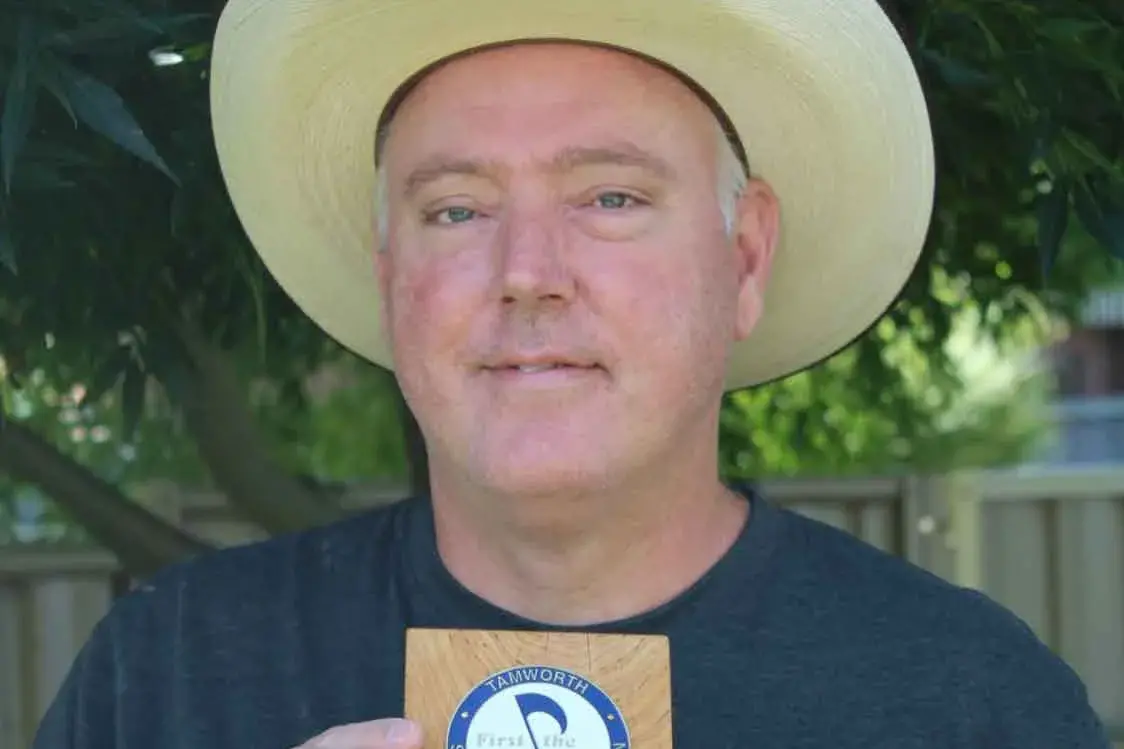
PHOTO
He's got songwriting awards from Tamworth and beyond, but Justin Landers is not chasing fame, nor trying to be the next Keith Urban, and laughs at the suggestion. What he is chasing is something far more enduring: honest stories, carved slowly into song.
Justin’s earliest memories are of clouds over Orange and the wide, dry country around Cobar, where his family moved in 1979 on doctor’s orders. Both he and his father had chronic lung issues. “The doctor suggested we need to move somewhere warmer and drier.” Out in Cobar, the soundtrack to his childhood wasn’t radio — they often didn’t have one — but what they did have was Mum’s vinyl collection.
“Mum was a record collector,” he says. “Mum’s music was our entertainment.” The Beatles, Elvis, sixties and seventies pop. “Mum’s music made Dad’s music stand out,” Justin says of the contrast that shaped him. Dad preferred the old classics — Patsy Cline, Kenny Rogers, songs that carried feeling, weight, stories.
Music also lived in the hands of the men before him. His grandfather — his “Pop” — was the family pianist, the one-man entertainment system for outback gatherings before record players were common. His father played the accordion: “Dad could play the squeeze box… but he could only play one song. We’d ask him at Christmas to learn some carols and he’d play ‘Jingle Bells’ to the tune of ‘We’re Going Back to Yarrawonga’.”
Justin’s musical journey started with a toy keyboard glued to the back of a book, then a cheap proper keyboard, and eventually guitar at 18 or 19. He gravitated to his parents’ favourites, including Merle Haggard, and the timeless storytellers. Country hadn’t yet consciously arrived in his life. In his early twenties, newly moved back to Orange and newly married, he joined guitarist Eddy Freedman in the popular local band Warp Two. Packed pubs, sweaty dance floors, pub rock covers — it was a thriving scene.
He tried writing his first song 'A Bottle of Wine'. The song is now lost to time, but the desire wasn’t. Then, life carved a deep mark. Eleven years ago, Justin lost his sister and niece in a car accident — an unspeakable grief that unravelled friendships, shifted priorities, and ultimately pushed him inward toward the only thing that helped: writing.
“I had to get stuff out,” he says simply. Out of that darkness came 'Honey, Take Me Home', his first original song as a solo artist. Not explicitly about his sister, but born from the emotional wreckage she left behind.
Since then, the songs have come steadily, some wrestled into existence over months, others appearing like lightning. His award-winning bluegrass song 'Always Kiss Me Goodnight' arrived in twenty minutes. “It just fell out,” he says. The mystery of inspiration still surprises him. “I don’t know where it comes from… a direct line, I don’t know.”
Justin writes when life gives him space. He’s not the kind of songwriter who mines every moment for ideas. “If you do that,” he says, “you ruin your life.” Instead, he waits for the right spark — driving the bus listening to background music, or waking with a phrase in his head. His phone is full of half-sung lines; his notebooks are littered with song ideas waiting for their moment.
But he’s very frustrated that real life gets in the way of his creativity. As his lyrics in the song ‘Free Time and Money’ say: 'I don’t have time/ I don’t have money/ it’s just me and that back-breaking monkey/ Oh how my life would be so sweet/ free time and money’s what I need.'
As for influences, Alan Jackson is his north star — “the gold standard” — while Australian songwriting legend Allan Caswell fundamentally shaped his understanding of craft: “To suddenly discover that he wrote the theme song for 'Prisoner'… that was him? Wow.” Caswell’s discipline — meter, rhyme, clean storytelling — resonates deeply.
Although he's a massive fan of the Alan Jackson song 'Living on Love', if there’s one song Justin wishes he’d written, it’s ‘Rose and Rodeo’ by Brendon Walmsley, a masterclass in simple, perfect emotional clarity.
While his own songs increasingly reflect his life, he is careful, almost shy, about revealing too much of himself. “I don’t want to let too much of what’s inside me be known,” he admits. Yet his most powerful pieces come from those moments of honesty. 'My Old Man', written as a gift for his father’s 70th birthday, grew from teaching his son to move the car for the first time. In that tiny, ordinary moment, he glimpsed the echo of his father teaching him, and the song poured out. 'Rusty Austin Ute' traces his first driving lesson at age nine on a Cobar property, when he crashed the ute into a tree before his father showed him how to drive properly.
Working with producer Simon Johnson brings polish and access to world-class musicians. Writing with songwriter Kevin Pye gives Justin something precious: “You only have to do half the work,” he laughs.
Despite the awards, the albums, and the growing recognition, Justin remains grounded. Life comes first: work, family, responsibility. Music fills the cracks, the quiet hours. “I envy creatives who commit their whole life to it,” he says. “But I can’t do that. I have people to look after.”
That’s Justin Landers: a songwriter shaped not by ambition, but by real life in the Central West, by red dirt roads, by Mum’s record collection, by the ache of loss and the courage to keep singing anyway.
Lyrics: Copyright Justin Landers 2020.
• If you are an artist, film-maker, photographer, musician, comedian, writer, or do something wonderfully creative and wish to be considered for inclusion in this series in 2026, please drop an email to stulloyd.worldsmith@gmail.com and talk yourself up.