
PHOTO
With the Ashes test series drawing the attention of cricket-lovers around the globe, Orange City Life decided to delve into the local history of the game and a little on our own link to the long-running sporting rivalry between Australia and England.
Cricket has been played in the district from the very earliest days of European settlement, quite possibly even predating the founding of Orange or Blackman’s Swamp as the fledgling village was first known.
But it is in 1856, just a few years after the first land sales in Orange, that we find a report in the Bathurst Free Press and Mining Journal on what could be one of the very first organised cricket matches in the new village.
“Sociability is an innate principle of man, and unless he can gratify it in some laudable pastime or other, he will most assuredly be led to indulge in practices which are not very elevating to the human character, and as a guard against such fearful consequences in this locality, the lovers of cricketing met on the first instance in our township where two full sides were quickly chosen, and at it they went.”
The unknown correspondent unfortunately doesn’t give us the results of this early match, but does express surprise at the “skill and dexterity of some of the players, considering their want of practice.”
“I am fully satisfied by this day’s exhibition that there are ample materials in Orange for a first-rate cricket match,” they conclude.
Reading these early news reports, the enthusiasm for the game of cricket is unmistakable.
“Like many other provincial towns, Orange has been affected with cricket mania,” says the Bathurst Free Press again in 1862.
However, this mania for cricket seems to have raised the ire of the more pious members of the community,
“Twenty or thirty men and boys cricketing and playing marbles on the Sabbath is a disgrace to a Christian community, and calls for suppression,” writes one disapproving correspondent lamenting the lack of a clergyman in the district.
Crickets' popularity and uptake was greatly aided by the Moulder family, who seem to have hosted the very first local ‘cricket ground’ on their land.
Joseph Moulder was an emancipated convict and one of the first people to purchase land in the district. His properties bordered the southern and eastern sides of the village, essentially the areas immediately south of Moulder Street and east of Peisley Street.
Joseph’s home “Endsleigh” still stands today at the southern end of Endsleigh Avenue and throughout the 1850s and 1860s we find reports of cricket being played “on the green in front of Mr Moulder’s house” or simply in “Mr Moulder’s paddock”.
“Mr Moulder, who had spent considerable pains in the formation of the club and the arrangements for the match, extended his assistance by offering the use of his paddock for the occasion,” wrote one correspondent describing the new cricket club’s first match in 1862.
Joseph’s sons, Edward and William were both enthusiasts for the game. William, in particular, was recognised as a champion bowler and in the 1862 match referred to above, William took 11 wickets from 79 deliveries, giving away just 24 runs.
While the Moulders were no doubt accommodating, it wasn’t long before Orange’s sporting fraternity could see a need for a public cricket ground, and as early as 1860, there were meetings to pursue that goal.
The result was the dedication of a “Cricket Reserve” in 1866, the area we now know as ‘Wade Park’, which has been the home of cricket in Orange ever since.
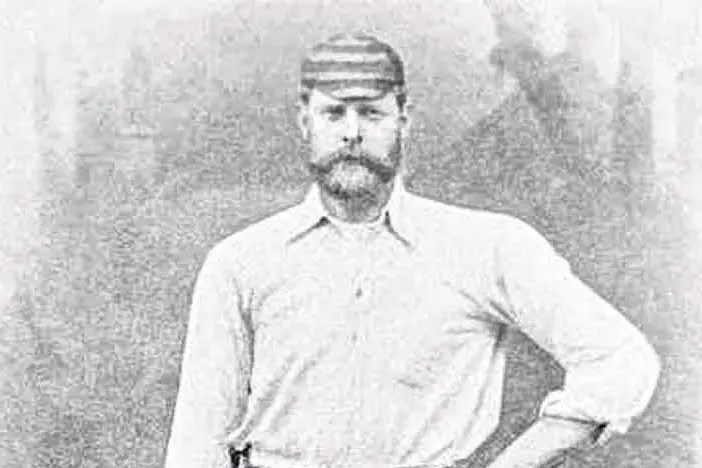
Of all the great cricketers who have played at Wade Park over the years, there are few more colourful than the big-hitting George John Bonnor, who was a member of the 1882 Australian side that defeated England at The Oval, giving birth to ‘The Ashes’ cricket series.
Born in Bathurst in 1855, before later moving to Orange, Bonnor played a total of 17 test matches for Australia and toured England five times.
At 6 foot 6 inches, Bonnor was a giant man for his day, handsome, athletic and a powerful hitter of the ball. He was a popular figure with the English cricketing public during his debut tour in 1880 and was nicknamed ‘The Colonial Hercules’ and ‘Bonnor the Basher’.
Famously, in his first appearance at The Oval in 1880, Bonnor hit a ball so high that by the time it was caught on the boundary by G.F. Grace, he had almost completed his third run.
Another time at The Oval, he is said to have hit a ball into the office of the Surrey Cricket Club secretary, knocking keys from his hand and smashing a framed photograph mounted on the wall.
And at the Sydney Cricket Ground, Bonnor once hit a ball over the Members’ Pavilion and into a Hansom cab waiting at the rank behind.
Opening the batting for Orange against Bathurst at Wade Park one Saturday, Bonnor sent a ball soaring high in the direction of the railway goods shed. A search party failed to locate the ball, so another was found, and the match resumed.
Three days later, Bonnor’s six finally fell to earth when the porter in charge of the goods shed at Bourke removed the tarpaulin from the railway truck that had carried the stowaway ball 500 kilometres from Orange.